Preclinical Evidence for GLP-1 Agonists in Alcohol Use Disorder
Rodent studies show GLP-1 drugs reduce alcohol intake by dampening reward signals in the brain.
Alcohol use disorder still has a drug problem, and it is not the one most people assume. Naltrexone, acamprosate, and disulfiram work for some patients but leave a large share without meaningful relief, and Bernstein and Schacht (2025) frame them as the benchmark against which new candidates must be judged. Unhealthy alcohol use contributes to 2.6 million deaths worldwide each year, a figure that has held steady long enough to count as settled. Relapse rates stay high and treatment uptake stays low. The shortfall in drug options compounds rather than gets absorbed by counseling and behavioral programs. Behavioral treatment can do real work, but it was never built to substitute for a missing pharmacological option, and that shortage is what has left room for a class of drugs nobody would have guessed belonged in this conversation a decade ago.
GLP-1 receptor agonists, originally developed for type 2 diabetes, have emerged as an unexpected candidate to fill this gap. Calling this unexpected risks making it sound like a lucky accident, and it was not. The hypothesis had a biological basis from the start: the same receptor system that regulates glucose and appetite also touches circuitry involved in reward and craving, so researchers had a real reason to ask whether a drug that blunts the pull of food might also blunt the pull of alcohol. What that biological overlap actually looks like, and how far it extends into the brain's reward system, is where the case for GLP-1 agonists in AUD has to start.
Where GLP-1 receptors sit in the brain's reward architecture
GLP-1 receptors show up throughout the mesolimbic and corticolimbic circuits that govern reward and motivation, including the ventral tegmental area, the nucleus accumbens, the amygdala, and the hippocampus. That distribution is the physical reason a hormone built for metabolic regulation could plausibly touch drinking behavior. GLP-1 is not confined to the gut. Intestinal L cells release it, but so do neurons in the brainstem, giving the peptide a direct route into brain tissue rather than requiring it to work solely through peripheral signaling. Once GLP-1 receptors are activated in these regions, the downstream effects may extend to dopaminergic, glutamatergic, and GABAergic signaling.
The anatomy establishes plausibility, and a systematic review from 2026 pushes it one step further before moving to the behavioral data. Researchers looking for a direct, isolated effect on nucleus accumbens activity or on GLP-1 receptor expression in that single structure did not find consistent evidence for one. What they did find was altered connectivity between the nucleus accumbens and the orbitofrontal cortex, pointing to a distributed circuit rather than a single receptor-dense hotspot as the likely site of therapeutic action. That distinction changes what a treatment has to accomplish. A drug reaching one small nucleus is a different pharmacological target than a drug that needs to sustain influence across a connection spanning two separate brain regions, and that difference becomes central again once the conversation turns to how these drugs actually get delivered to the brain in practice. For now, the anatomy establishes a plausible home for the effect. What the effect actually looks like in behaving animals is a separate question, and the preclinical record answers it in some detail.
What the preclinical record shows about GLP-1 agonists and alcohol behavior
Rodent studies give a consistent picture: across models, GLP-1 receptor agonists reduce how much alcohol animals drink, how readily they relapse into drinking after abstinence, and how strongly alcohol-associated cues pull their behavior. That consistency alone would be notable. What makes the finding harder to dismiss as coincidence is that researchers have actually watched the drug get to where it needs to go. Fluorescently labeled semaglutide has been detected directly in the nucleus accumbens of alcohol-drinking rats, confirming that the molecule crosses into the central nervous system and reaches the target tissue rather than acting only through some peripheral signal.
Once there, the effects line up into a coherent chemical story. In male mice, semaglutide reduced the dopamine surge that normally accompanies alcohol consumption, while also raising levels of the dopamine breakdown products DOPAC and HVA in the nucleus accumbens and increasing expression of the enzymes COMT and MAOA, which metabolize dopamine. Every piece of that points the same direction: less dopamine signal, faster dopamine clearance, a blunted reward response to the drink itself. The effect is not limited to semaglutide, either. Semaglutide, tirzepatide, and retatrutide all reduced the interoceptive effects of alcohol, the internal, subjective sense of the drug's presence in the body that partly drives continued use. That finding matters because it suggests GLP-1 agonism is not just making animals drink less through some indirect route like appetite suppression. It appears to be dampening how alcohol registers as a rewarding stimulus.
A broader 2026 systematic review, covering dozens of studies with the large majority preclinical, extended this pattern beyond alcohol to other substances. Exendin-4, liraglutide, and semaglutide reduced intake, relapse-like behavior, and cue-triggered drug seeking, with the effects tied to GLP-1 receptor activation in the nucleus accumbens, ventral tegmental area, and the nucleus of the solitary tract. One structural finding stands out from the rest because it describes repair rather than suppression. Liraglutide restored dendritic spine density in the medial prefrontal cortex and hippocampus, regions known to sustain damage during alcohol withdrawal, back to normal levels. That is not the same mechanism as blunting a dopamine spike on the day of a drink. It points to actual neuroprotection, a structural recovery process running on a slower timescale than acute reward blunting.
Timing itself turns out to vary by drug. Semaglutide reduced alcohol consumption on the day it was injected, a fast, acute effect, while liraglutide increased water intake and produced a longer-lasting reduction in alcohol intake that unfolded over a different timescale. Different molecules in the same drug class are not interchangeable in how quickly or how durably they act, a detail that will matter for anyone designing a dosing schedule around one agent instead of another.
The single most important constraint to come out of the entire preclinical record is the washout finding, and it deserves to be stated without softening. When GLP-1 receptor agonist exposure stopped, alcohol intake in these animal models returned to baseline. The effect did not persist after the drug cleared. That result sets a hard requirement for any treatment built on this mechanism: the therapeutic effect depends on sustained receptor engagement. A delivery approach that cannot keep brain concentrations of the drug within a therapeutic range continuously will not hold the reduction in drinking that the rest of the preclinical data demonstrate. That single constraint is the hinge between what happens in animal cages and what has to happen in a clinic, and it resurfaces directly in the discussion of delivery near the end of this piece.
One more piece of evidence gives the whole mechanistic story more weight. A comparison between GLP-1 receptor agonists and DPP-4 inhibitors, another class of diabetes drug that raises endogenous GLP-1 levels through a different pathway, found that GLP-1RA recipients in a large VA cohort study showed greater reductions in alcohol consumption than DPP-4 inhibitor recipients. In rodents, DPP-4 inhibitors lowered blood glucose just as effectively as GLP-1 agonists but had no effect on alcohol intake, which rules out the possibility that the drinking reduction is some side effect of glucose control rather than a direct consequence of GLP-1 receptor engagement. That comparison does more for mechanistic confidence than almost any single dose-response experiment could, because it isolates the active ingredient: activation of the GLP-1 receptor itself, not some downstream metabolic side effect shared across diabetes drugs generally.
Where the preclinical signal breaks down in human studies
Early human data point in the same direction as the animal studies, but the evidence is patchy enough that no one studying it closely is calling the question settled. A Phase 2 randomized trial enrolled 48 nontreatment-seeking adults with AUD, average BMI of 32, and gave them semaglutide at doses between 0.25 and 1.0 milligrams subcutaneously against placebo over nine weeks. Participants on semaglutide who had moderate AUD had significantly fewer drinking days during weeks five through. Separately, a pharmacoepidemiology analysis looking at a large population with a history of AUD found that prescriptions for GLP-1 receptor agonists were associated with a meaningful drop in the rate of alcohol intoxication. That is an association drawn from prescription and outcome records, not a randomized comparison, and it should be read as a real estimate that GLP-1 prescribing correlates with less intoxication, not as proof that the drug alone caused the change in every patient captured in the dataset.
The trial built to settle the causal link directly is still running. The CRAVE trial, sponsored through the VA, is a Phase 3 randomized controlled trial testing semaglutide against placebo in veterans with moderate to severe AUD, with primary completion estimated for March 2029. Until that data set reads out, the strongest available human evidence remains a mix of one modestly sized Phase 2 trial and observational associations, both encouraging, neither definitive.
The meta-analytic picture actually complicates the story rather than resolving it. Bernstein and Schacht's 2025 review found that a pooled analysis of three randomized trials showed a non-significant overall association between treatment and reduced drinking, whereas observational studies showed a robust association, a discrepancy reflecting trial heterogeneity rather than a null effect. That gap between trial design types is not a reason to write off the drug class. The exenatide trial run by Klausen and colleagues had high attrition, with fewer than half the patients in either arm completing 26-week follow-up, and both arms received cognitive behavioral therapy alongside the study drug, which may have attenuated the drug effect. A trial that loses more than half its participants before follow-up, and that gives both groups an active behavioral treatment on top of the study drug, is not well positioned to detect a modest pharmacological effect. The heterogeneity in the pooled result reflects differences in how the three trials were built.
The effect also does not generalize evenly across every substance use disorder researchers have tested it against. Clinical findings in cocaine use disorder reported no significant treatment effect, reinforcing that not all substances respond equally. One might ask why cocaine and alcohol would respond so differently to the same receptor mechanism. Part of the answer likely traces back to the earlier point about circuit-level action: alcohol's effects on dopamine signaling and cortico-striatal connectivity may overlap with GLP-1 receptor biology in ways that cocaine's more concentrated dopamine transporter blockade does not.
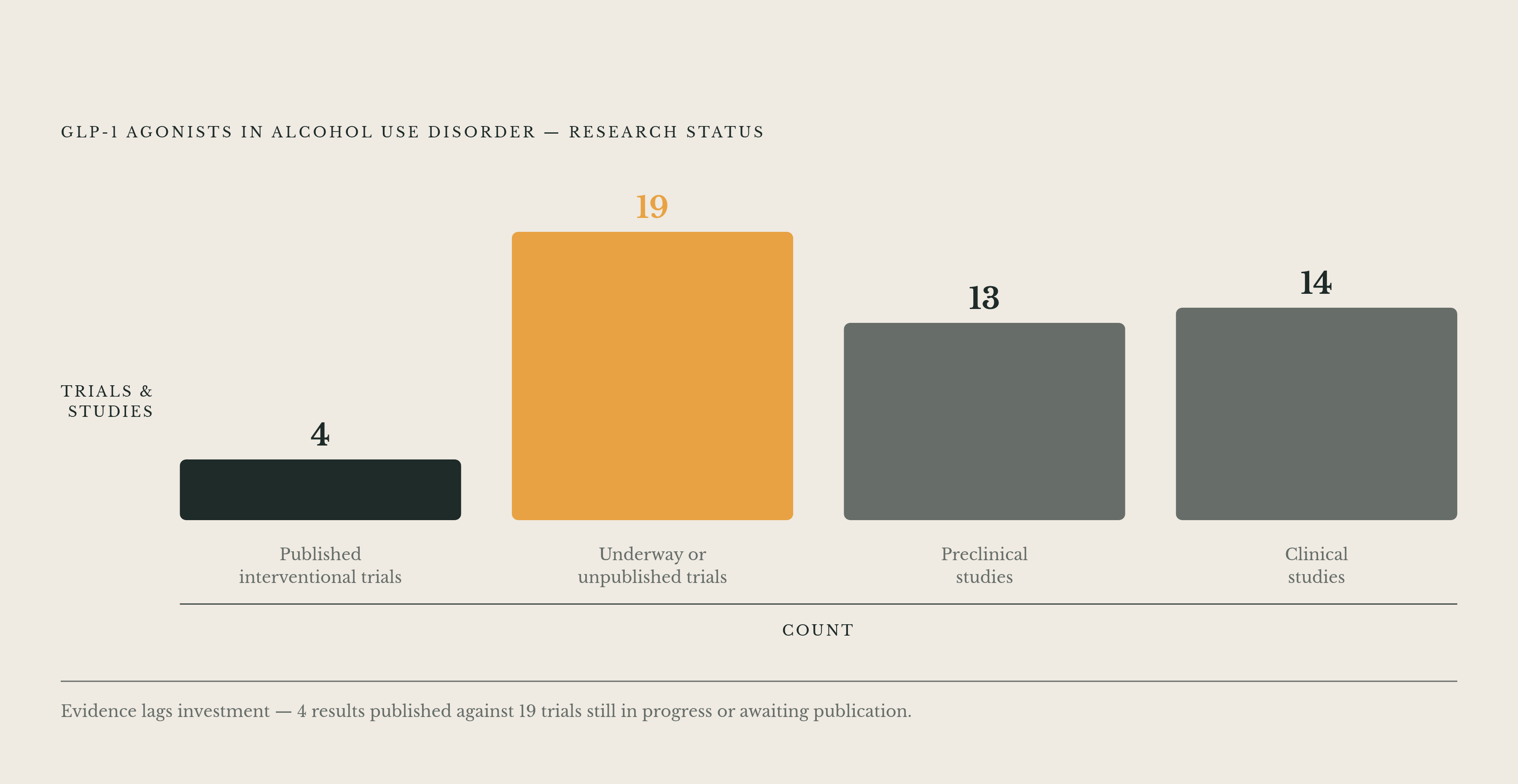
A narrative review in Alcohol, Clinical and Experimental Research took stock of the field's overall shape and found 13 preclinical studies, 14 clinical studies, 4 published interventional trials, and 19 more interventional trials either underway or completed but not yet published. That last number, 19 unpublished or in-progress trials against only 4 published ones, says something important about where the field stands right now. The volume of active research reflects genuine scientific conviction that this mechanism is worth pursuing at scale. The scarcity of published results from most of that activity means the evidentiary base has not caught up to the level of investment yet, and conclusions drawn today have to carry that caveat. Among the drugs tested so far, semaglutide has produced the largest effects on alcohol-related outcomes, though whether that reflects something specific to its pharmacology or simply the doses and trial designs used to test it remains an open question.
Injectable delivery and the AUD patient population
Every question raised so far, about mechanism, about dose, about how long an effect lasts, eventually runs into a practical constraint: how the drug actually gets into the patient, day after day, for as long as the washout finding says it has to. GLP-1 receptor agonists carry a well-documented side effect profile centered on the gut: nausea, diarrhea, vomiting, and constipation are the most common complaints. For most patients starting these drugs for metabolic reasons, that profile is an inconvenience to manage. For patients with AUD, it lands on top of gastrointestinal systems that chronic alcohol use has often already stressed, which raises the practical burden of tolerating the drug in exactly the population these trials are trying to treat.
Treatment-emergent gastrointestinal side effects appear in the discontinuation data. Treatment-emergent gastrointestinal side effects lead a meaningful fraction of patients to stop the drug outright, and push a larger fraction into reduced doses during the early weeks of treatment. That timing is not incidental. The side effects are worst right after a patient starts or increases a dose, and they tend to ease over the following weeks as the body adjusts. The most pronounced effects occur acutely upon initiation and wane over the first weeks of treatment, precisely the window when a patient with AUD is most vulnerable to dropout. Layering a rough side-effect onset period on top of a population already prone to early attrition creates a specific adherence problem, distinct from the general tolerability issues GLP-1 agonists raise in metabolic patients. Whether alternative delivery approaches can soften that early burden, while still sustaining the continuous receptor engagement the washout data demand, is the question the field has to answer next before this mechanism can move from a promising preclinical story into a treatment patients can actually stay on.
Sources
- GLP‐1 Receptor Agonists for Treating Alcohol Use Disorder: A Critical Review - Woo - 2026 - Alcohol, Clinical and Experimental Research - Wiley Online Library
- Distilling the evidence for GLP-1 receptor agonists in alcohol use disorder
- JCI - GLP-1 receptor agonists for the treatment of alcohol use disorder
- Once-Weekly Semaglutide in Adults With Alcohol Use Disorder: A Randomized Clinical Trial - PubMed