GLP-1 Market Size, Key Players, and the Race to Solve Compliance
Oral formulations may solve the compliance crisis that injections cannot.
GLP-1 receptor agonists have become one of the largest drug categories in the world, and the reason has little to do with marketing and everything to do with where the receptor sits in the body. GLP-1 is a hormone the gut makes on its own, and it does several jobs at once: it tells the pancreas to release insulin, tells the liver to stop pushing out glucagon, slows down digestion, and signals the brain's hunger circuits to quiet down. Because the receptor shows up in the brain, pancreas, heart, and gut, a single molecule designed to activate it can move the needle on diabetes, obesity, and cardiovascular risk at the same time, which is a rare thing for any one drug class to pull off. Market research firms disagree on the exact dollar figures, but the trajectories all point the same direction: multiple firms place the current global market in the tens of billions of dollars, with sustained double-digit compound growth projected through the mid-2030s, the directional story consistent even where exact figures differ across methodologies. North America currently holds the largest share of that market, but Asia-Pacific is growing faster than anywhere else, which says the category hasn't come close to reaching full global penetration yet. And the patient pool keeps widening from multiple directions at once: diabetes and obesity prevalence are both climbing, cardiovascular approvals keep expanding what the drugs are indicated for, and generic competition has arrived, with Teva's generic version of liraglutide (referencing Saxenda) cleared in August 2025 for chronic weight management. Doing so makes the GLP-1 market look less like a typical pharma cycle, the kind that rides a patent for a decade and then fades; it looks more like a durable structural shift in how chronic metabolic disease gets treated. That durability raises the question this piece is built around: if the market is this large and this entrenched, what decides who wins it from here?
How the competitive field is organized today
Market leadership in the GLP-1 field today is defined by molecule type and delivery format, but the field is fragmenting fast as challengers pursue differentiated routes rather than head-to-head peptide competition. The injectable peptide tier is still where most of the revenue lives. Semaglutide holds the largest share of the market by individual product, while tirzepatide, a dual agonist that hits both the GLP-1 and GIP receptors, is growing faster than any other single product in the category. That's the tier most people picture when they hear "GLP-1 drug," the weekly injection pen.
But a second tier has opened up underneath it, and it's growing in a different way. Roots Analysis found that small-molecule oral GLP-1 agonists now account for nearly 55% of the market by molecule type, largely because small molecules are cheaper and easier to manufacture at scale than injectable peptides. Orforglipron, sold as Foundayo and approved in April 2026, is the first non-peptide small-molecule GLP-1 receptor agonist cleared for obesity, and it works as a standard oral drug without needing any special technology to help it get absorbed. That's a meaningfully different manufacturing and distribution story than a peptide that has to survive the stomach.
A third pressure point appears at the edges of the patent system. None of this means the injectable peptide tier is losing its footing today. It means the market is no longer a contest between a handful of injectable molecules competing on potency and side-effect profile alone. It's splitting into competing delivery philosophies, and that split is what makes the next question (how patients actually experience and stick with these drugs) the one that will likely decide who leads the category over the next decade rather than who has the strongest weight-loss data this year.
The oral pivot as a compliance story
Every major pharmaceutical company racing to get an oral GLP-1 to market is making a quiet admission: the injection model, no matter how effective the molecule inside the pen, has a problem that no amount of additional efficacy data can fix. Patients are not staying on these drugs long enough to realize the benefit, and the industry's response has been to change the delivery format rather than the biology.
The scale of the bet being placed on that idea is striking. Goldman Sachs analysts project that oral formulations could capture roughly a quarter of the global weight-loss drug market by 2030. That's not a forecast about new patients coming into the category for the first time. It implies a wave of existing injectable users switching formats, which only makes sense if the injection itself, not just the drug's effectiveness, is the thing standing between patients and long-term use.
The data on where the market actually sits today supports that read. Roots Analysis confirms that the oral route is currently the fastest-growing route of administration, even though parenteral delivery still accounts for most of the volume prescribed right now. The shift is underway, but it hasn't come close to finishing.
The oral pivot leaves a gap in what it solves: in November 2025, the federal government announced agreements that substantially lowered the monthly price of GLP-1 weight-loss drugs for eligible patients, with Medicare set to begin covering select groups starting in mid-2026. That tackles one real barrier to staying on therapy: cost. But price has never been the only reason patients quit, and a cheaper injection or a cheaper pill does nothing to change what happens once the drug is actually circulating in a patient's body. That gap, between what the oral pivot addresses and what it leaves untouched, is where the compliance crisis actually lives, and it's the subject of the next section.
The scale of the compliance crisis the oral pivot is trying to fix
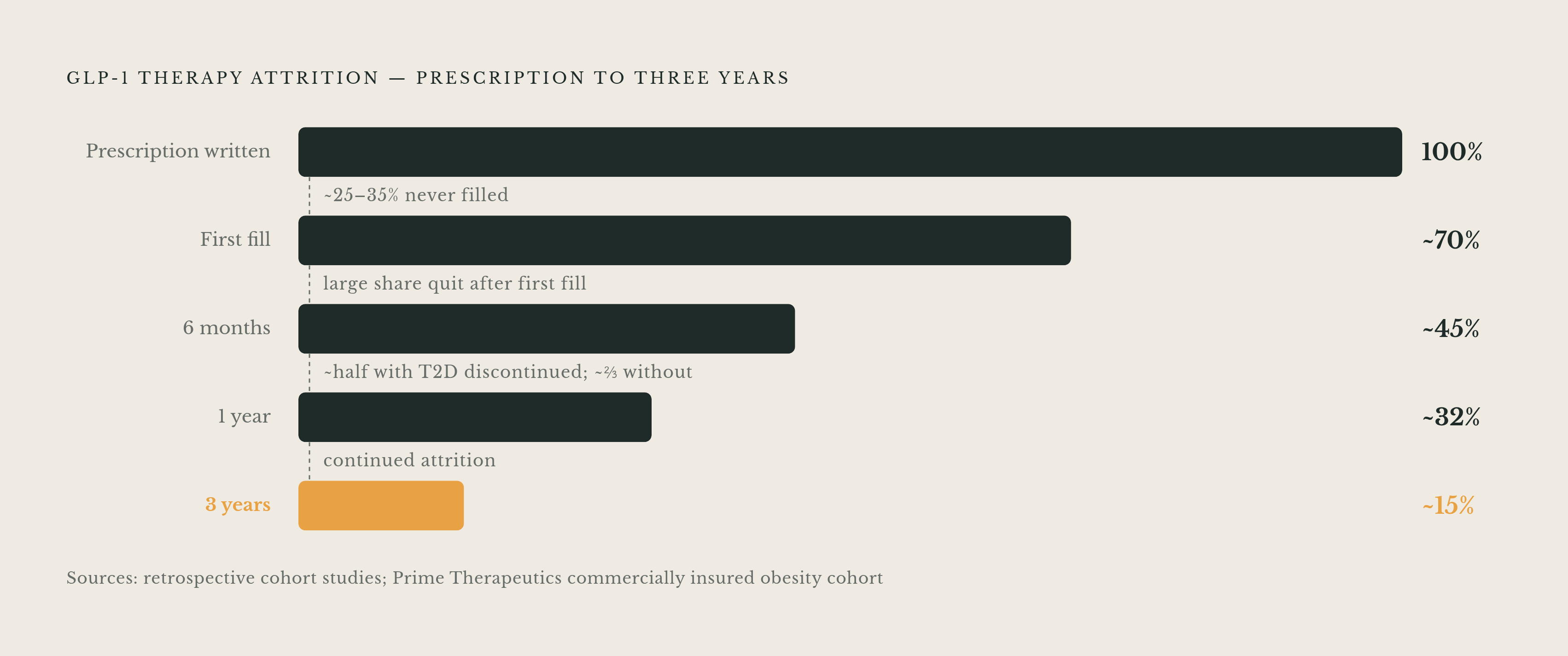
The numbers on GLP-1 persistence describe a pattern that repeats across nearly every dataset available: patients start, run into a wall, and quit, often faster than the drug has any real chance to work. More than half of all patients who begin GLP-1 therapy abandon it within a year, and the steepest drop-off happens right after the first fill. According to an IQVIA analysis cited in industry research, a meaningful share of approved prescriptions never even get filled at the pharmacy counter, and another large share of patients stop immediately after that first fill, so the therapy fails a sizable portion of patients before it has had any chance to produce results.
The attrition doesn't stop after the first few months, either. Prime Therapeutics data on commercially insured patients being treated for obesity without diabetes found that only a small fraction remained on therapy at the three-year mark. A separate retrospective cohort study tracking a large adult population that started on liraglutide, semaglutide, or tirzepatide found that nearly half of patients with type 2 diabetes, and almost two-thirds of those without it, had discontinued within a year. A Danish population study of a large cohort of first-time semaglutide users found that a majority had discontinued within a year, with researchers pointing to high out-of-pocket costs, gaps in insurance coverage, and adverse effects as the primary drivers, especially among younger and lower-income patients.
What ties these numbers together is the mechanism behind them. Gastrointestinal side effects, nausea, vomiting, and diarrhea, are the dominant reason patients give up, and more than half of all patients on GLP-1 injections report experiencing nausea. That single side effect appears to carry more weight in whether a patient stays on therapy than almost any other factor measured.
And the burden doesn't fall evenly. Among Massachusetts Medicaid members studied for a 2026 JMCP analysis, six-month persistence was just 60.8%, with the lowest rates among male patients, those under 40, and those without any weight-related comorbidities. That last detail deserves a second look: the patients carrying the most metabolic risk, the ones who stand to benefit most from staying on therapy, are often the least likely to stick with it. Why would that be the case? One plausible answer sits in the next section: if nausea is the single biggest driver of dropout, then the format delivering the drug into the body matters just as much as the molecule itself.
Nausea as a delivery problem
The nausea driving most GLP-1 discontinuation traces back to how the drug enters the body, not to what GLP-1 does inside the brain. That distinction matters, because it changes the problem from "how do we make a drug that doesn't cause nausea" into "how do we deliver the drug we already have without triggering the nausea pathway." One is a chemistry problem. The other is an engineering problem, and engineering problems tend to have more tractable solutions.
To see why, it helps to look at where GLP-1 receptors actually sit. Receptors in the hypothalamus and brainstem are the ones responsible for satiety and the metabolic effects patients want. Receptors in the gut and in a brain region called the area postrema, which sits outside the blood-brain barrier, are the ones that trigger nausea when circulating peptide activates them. A subcutaneous injection puts the drug straight into systemic circulation, and systemic circulation means the gut and area postrema receptors get exposed to peptide before any of it reaches the central targets the drug is supposed to act on. The nausea is the predictable consequence of the delivery route guaranteeing peripheral exposure first.
Research from Khan and colleagues in 2024 laid out the core of this argument directly: subcutaneous GLP-1 drugs have to cross the blood-brain barrier to reach the targets that actually produce their benefit, and the researchers proposed that nasal delivery could reach the brain at higher concentrations while exposing the rest of the body to far less circulating peptide, which in turn would reduce gastrointestinal side effects, making the mechanistic case for rethinking delivery altogether.
It also explains something that might otherwise seem puzzling about the current oral pivot. Oral semaglutide still has to get absorbed through the gastrointestinal tract and enter systemic circulation to work, so the peripheral receptor exposure, and the nausea pathway that comes with it, remains very much in play. Swapping the needle for a pill removes one barrier to compliance (the needle itself) but leaves the biological one largely intact. Solving compliance at its source means routing the drug to the brain without saturating the gut on the way there, a distinction the market hasn't fully reckoned with yet.
Why the nasal route suits GLP-1 biology
If systemic exposure is the mechanism behind GLP-1 nausea, any delivery route that reaches the brain while minimizing what circulates through the rest of the body deserves close examination. The nasal cavity offers two such routes, and both bypass the blood-brain barrier entirely rather than trying to cross it.
The first is the olfactory pathway, which moves molecules directly along the olfactory nerve, cranial nerve I, into the brain. The second is the trigeminal pathway, broader in its distribution but slower, running along cranial nerve V. Neither pathway requires the drug to enter the bloodstream at all, which is the anatomical detail that makes the nasal route biologically interesting for a class of drugs whose main side effect comes specifically from systemic circulation.
Early preclinical evidence backs up the speed of this transport. Intranasally administered nanoparticles have shown up in the olfactory bulb within minutes of dosing, demonstrating that the directional movement from nose to brain happens fast. In a separate line of research, a GLP-2 derivative attached to a cell-penetrating peptide reached the trigeminal principal sensory nucleus within minutes of intranasal dosing in mice, and the same research group later found that GLP-1 derivatives also move through trigeminal neurons after nasal administration.
None of this means the engineering problem is solved. Semaglutide and similar peptides are large molecules, and getting them to survive the nasal environment, the mucus that clears material out, the enzymes that degrade peptides, the epithelial tissue that resists permeation, while still reaching the brain at a concentration high enough to matter clinically, remains unresolved at clinical scale. That's the real barrier standing between the preclinical science and a usable drug.
The field's response has been to stop relying on simple nasal sprays and start building delivery systems with multiple components designed to tackle each barrier at once: nanoparticles, liposomes, nanoemulsions, thermosensitive gels, and mucoadhesive formulations that cling to nasal tissue long enough for absorption to occur. A 2026 study published in Biomaterials by Conejos-Sánchez and colleagues introduced a platform called NanoInBrain, a modular hybrid biomaterial system designed to bypass the blood-brain barrier through the olfactory route, built around adjustable architecture, surface chemistry that responds to biological signals, and a depot mechanism for sustained release. That kind of multi-layered engineering is what separates the current wave of nasal delivery research from the simpler nasal sprays of a decade ago, and it's also why serious R&D money is starting to move toward this route.
Who is building in this space
The clearest sign that nose-to-brain GLP-1 delivery has moved past the hypothesis stage is who's now spending real R&D budget on it. Within roughly the past year, at least four separate organizations have announced or advanced intranasal GLP-1 delivery programs, each approaching the engineering challenge from a different angle.
Landmark Medicines Ltd. announced that it plans to advance its proprietary nasal drug-delivery platform into a human volunteer study, with GLP-1 receptor agonists named as the initial application and semaglutide listed among the candidate molecules still under evaluation ahead of final selection. The platform itself is formulation-agnostic: it isn't built around one specific molecule, and it's the subject of multiple patent filings. What makes the program notable from a research standpoint is its stated plan to investigate the olfactory and trigeminal pathways specifically as a nose-to-brain route, distinct from ordinary systemic nasal absorption, which puts it directly in line with the mechanistic argument laid out in the preceding section.
Aptar Pharma announced in May 2026 the publication of three new international patent applications focused on enabling inhaled and nasal delivery of GLP-1-based therapies, part of an internal strategic R&D effort aimed at expanding the company's biologics delivery capabilities. MetP Pharma announced new data from its MetP Technology platform, built around intranasal delivery of semaglutide along with other peptides designed to target the brain.
Four distinct organizations, four distinct technical bets, all converging on the same underlying wager: that the next real gain in the GLP-1 market won't come from a stronger molecule, but from a delivery system that finally lets these drugs reach the brain without paying the systemic price that drives more than half of all patients to quit. Whether any of these platforms clears the barrier that has stalled nasal peptide delivery for years, getting a molecule the size of semaglutide through mucus, past enzymes, and across nasal epithelium at a clinically meaningful dose, is still an open question. But the fact that multiple well-resourced organizations are now racing to answer it says the market has stopped treating compliance as a side issue and started treating it as the main event.
Sources
- GLP-1 Receptor Agonist Market to Grow at 17.5% CAGR till 2035
- GLP-1 Receptor Agonist Market Size, Share & Forecast 2035
- GLP-1 Receptor Agonist Market Size, Share
- Real-world 6-month persistence, adherence, and effectiveness of GLP-1 medications for overweight and obesity in a Medicaid population
- GLP-1 RA Adherence Shows Drop-Off After 1 Year