GLP-1 Agonist Dropout Rates and Adherence Data
Most patients quit within a year, long before the drug can deliver its proven effects.

GLP-1 receptor agonists produce some of the largest average weight reductions ever recorded for a pharmacological obesity treatment in controlled trials, yet those numbers rarely appear at the population level once the drugs leave the trial setting. The gap between what the molecule can do and what it actually does across millions of real prescriptions is wide enough that it needs its own explanation, separate from any question about whether the drugs work.
The excitement around this drug class was built on trial data: sustained, substantial weight loss in patients who stayed on therapy for the full study period. But what if the trials measured something that almost never happens outside of them? Clinical trials enforce adherence through structure, monitoring, and selection. Real-world use enforces nothing. That difference alone accounts for a meaningful share of the gap between the headline numbers and what shows up in claims data, pharmacy records, and health system reporting. The drug is not failing to perform. Most patients are not on it long enough for it to perform, and that distinction reframes every adherence figure that follows as evidence of a structural problem.
How GLP-1 Users Stop Treatment
Discontinuation within the first year is what happens to most people who start a GLP-1, across different insurance arrangements, different countries, and different patient populations, and the consistency of that finding across independent datasets turns it from an isolated statistic into a structural feature of how these drugs are used.
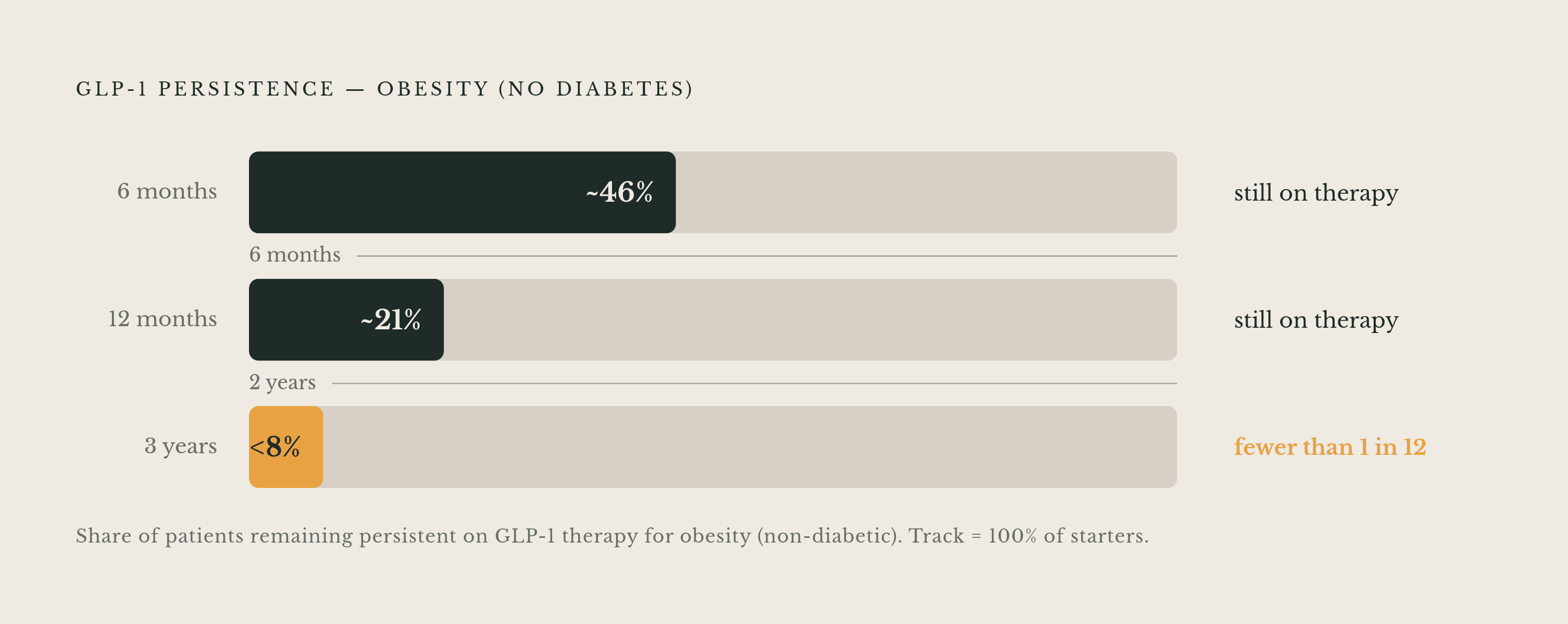
The shortest time horizon tells the clearest story. A 2026 national cross-sectional survey of US adults found that more than half of discontinuers had stopped a GLP-1 receptor agonist within 6 months of starting, and roughly four in five had discontinued by the 12-month mark. Extend the window slightly and a JAMA Network Open cohort study of a large patient population found that nearly half of patients with type 2 diabetes discontinued within one year, compared with nearly two-thirds of patients without diabetes. That difference by indication carries real weight: it suggests the adherence problem is sharper among people using GLP-1 therapy primarily for weight loss rather than diabetes management, which is exactly the population driving the current growth in prescriptions.
The Medicaid data deserves particular attention because it covers a population facing more access barriers than commercially insured patients typically face. A 2026 study of Massachusetts Medicaid members found six-month persistence and adherence rates below the benchmarks set in clinical trials, with male sex, age under 40, and a diabetes diagnosis all associated with lower persistence. Among the subset of members who were highly persistent and adherent, though, the majority achieved clinically meaningful weight loss at 6 months. That contrast inside a single dataset makes a case the rest of this piece will return to: the drug works when it is taken, and the open question is why so many stop taking it.
Stretch the time horizon out further and the picture gets harder to look at. A narrative review drawing on data from Prime Therapeutics found that at three years, fewer than one in twelve patients who started GLP-1 therapy for obesity without diabetes were still persistent on treatment. Measured against that figure, the one-year numbers start to look almost encouraging.
None of this is happening against a backdrop of shrinking demand. A Truveta monitoring report identified millions of patients prescribed a GLP-1 receptor agonist between January 2019 and March 2026, with prescribing rates rising at their fastest quarter-over-quarter pace since 2019 in the most recent period the report tracked. Set that expansion next to the three-year persistence figure from Prime Therapeutics: a rapidly growing base of new patients funnels into a treatment experience that the overwhelming majority exit long before reaching anything like a therapeutic ceiling.
Early Dropout and Side Effects as a Structural Driver
The timing of dropout is not random. It clusters in the early months of treatment, which happen to be the months when gastrointestinal side effects are most intense, and that overlap is the first thread to pull on in understanding why so many people quit before the drug has a chance to work.
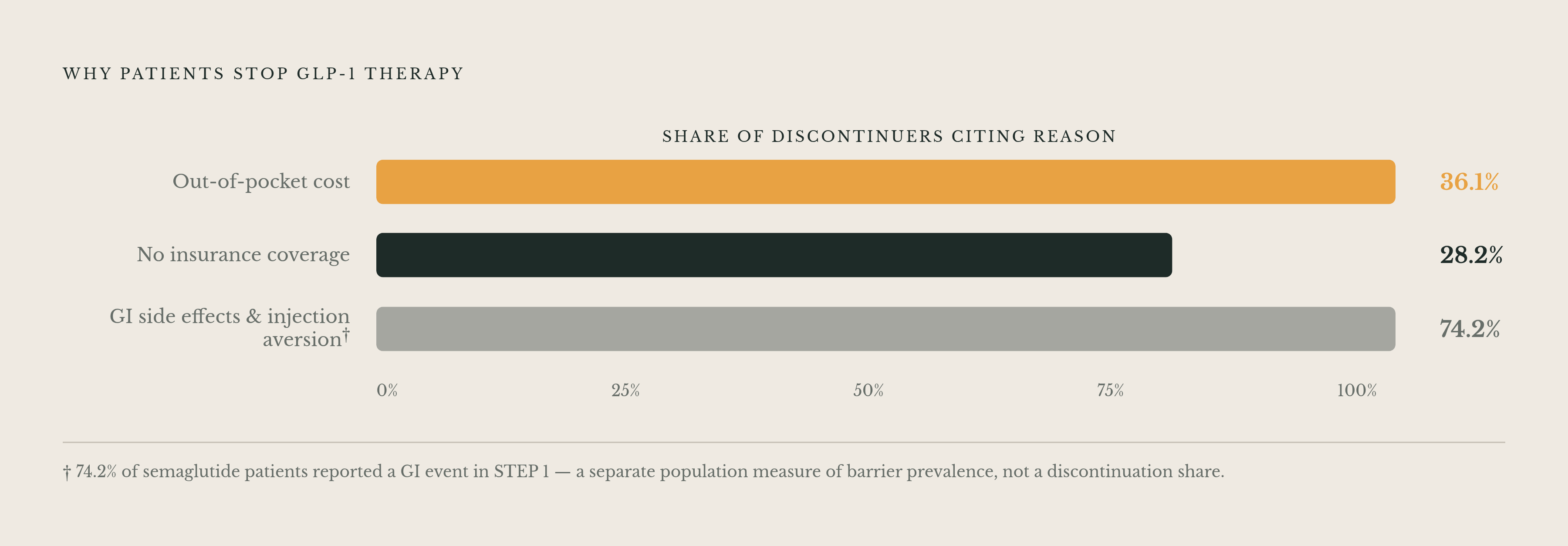
Gastrointestinal side effects are not a rare complication that affects a sensitive subset of patients. They are close to a universal feature of injectable GLP-1 therapy at the population level: 74.2% of semaglutide patients in the STEP 1 trial reported some gastrointestinal event. That figure comes from a controlled trial with monitoring and support most real-world patients never receive, which makes it a floor rather than a ceiling for what happens outside that setting.
Peripherally administered GLP-1 agonists act on GLP-1 receptors in the brainstem, specifically in the area postrema and dorsal vagal complex, and on peripheral GI receptors at the same time. Nausea, vomiting, and diarrhea follow from both pathways acting together, an on-target effect of how the drug engages its receptors. Because it means the side-effect burden is not something a better-tolerated version of the same molecule, delivered the same way, is likely to eliminate. The burden is built into the route.
The 2026 national survey identified adverse effects as one of the primary reasons patients gave for stopping, in their own words. And the standard dose-titration protocol for these drugs compounds the problem instead of resolving it: lower doses are more tolerable but produce less weight loss, which creates pressure to escalate, and escalation brings more intense side effects right at the point where patients are deciding whether the treatment is worth continuing. The cycle is built into how these drugs are currently dosed and delivered, not an incidental feature of individual cases.
The effect reaches backward in time as well. Fear of side effects discourages some patients from starting GLP-1 therapy in the first place, shaping who begins treatment.
The injection barrier and cost compound the side-effect problem
Side effects alone do not account for the scale of dropout documented across these datasets. Needle burden and affordability sit alongside gastrointestinal symptoms as independent reasons patients give for stopping, and the three factors reinforce each other to explain the same patients.
Starting an injectable therapy carries psychological weight that has nothing to do with tolerability. Injections are often read by patients as a marker that a condition has gotten more serious, and that association generates resistance even in patients who tolerate the drug's side effects reasonably well. This matters more as GLP-1 use spreads beyond its original diabetes population into broader obesity treatment, where many new patients have never given themselves an injection before and have no prior clinical relationship that might normalize the experience.
Cost operates as a separate, parallel barrier. The JAMA Network Open cohort and the 2026 national survey both flag cost and insurance coverage gaps as discontinuation factors, and the national survey specifically identified cost (36.1%) and lack of insurance coverage (28.2%) among the most frequently cited reasons for stopping. The pattern recurs in who is affected: younger patients and patients in lower-income areas discontinue at consistently higher rates across multiple datasets, with a 2025 analysis finding that users in low-income areas were 14% more likely to discontinue within the first year than users in higher-income areas. That is an affordability signal, not a biological one, since there is no pharmacological reason income should predict how a drug is metabolized.
The Medicaid study reinforces the same point from a different angle. It explicitly notes that real-world adherence in that population fell short of clinical trial benchmarks and calls out the importance of identifying access barriers as payers try to assess whether GLP-1 coverage delivers value. One might argue that fixing cost alone would solve most of the problem, given how often it appears in patient-reported reasons for stopping. But the side-effect data and the injection-aversion pattern persist independently of coverage status, which suggests that removing any single barrier, cost included, would leave the other two fully intact.
What discontinuation costs patients
Stopping a GLP-1 early is not a neutral event that simply returns a patient to where they started. Patients who discontinue before reaching a sustained duration of treatment forfeit the weight-loss benefit they had built up and frequently regain the weight, giving the adherence gap a direct clinical cost.
The Massachusetts Medicaid study demonstrates this by contrast within its own data. Among the members who were highly persistent and adherent, the majority achieved clinically significant weight reduction at 6 months. Set that finding against the overall persistence and adherence rates in the same cohort, both below clinical trial benchmarks, and the gap between trial efficacy and real-world outcomes starts to look like a question of who stays on therapy rather than a question of how the drug performs once administered.
That raises an important question about whether the patients who quit are rejecting the treatment altogether or simply failing to tolerate its current form. The reinitiation data from the JAMA Network Open study offers a partial answer: a portion of patients who discontinue go on to restart treatment later. That pattern points away from a story of patients deciding the drug isn't for them and toward a story of patients being unable to sustain the particular experience of taking it, the injections, the GI symptoms, the cost, at the moment they stopped. A design problem looks very different from a patient-preference problem, and the reinitiation signal leans toward the former.
Why delivery, not patient behavior, is the fixable variable
Line up the evidence from the previous sections: dropout concentrated in the early months when GI side effects peak, injection aversion operating independently of tolerability, cost and access barriers compounding both, and a meaningful share of patients who quit eventually trying again. Taken together, that pattern points toward the delivery mechanism as the variable actually open to change, not patient willpower or engagement.
To understand why, it helps to look at what these drugs are made of and how they currently reach the body. GLP-1 peptides degrade rapidly and have no meaningful oral bioavailability in their native form. That is why they are administered by injection in the first place. The side-effect burden is a direct consequence of the path the drug has to take to reach its target, built into the current delivery route itself.
That framing opens a specific engineering question. Could a delivery route that reduced peripheral GI receptor activation while maintaining or improving how well the drug engages receptors in the brain reduce side effects and remove the injection barrier at the same time?
The nose-to-brain pathway offers one scientifically grounded answer. The olfactory and trigeminal nerves provide a direct anatomical route from the nasal cavity to the brain that bypasses the blood-brain barrier entirely, and published research on nasal peptide delivery shows that nanocarrier systems, mucoadhesive formulations, and permeation enhancers can improve how much of a peptide reaches the central nervous system in preclinical models. On September 29, 2026, Landmark Medicines Ltd., a UK pharmaceutical development company, announced plans to progress its proprietary nasal drug-delivery platform toward a human volunteer study, selecting GLP-1 receptor agonists as the initial therapeutic application. That is a concrete signal that nose-to-brain GLP-1 delivery is moving out of preclinical research and into clinical investigation.
The olfactory epithelium covers only a small fraction of the total nasal surface area in humans, and getting a peptide to reliably cross it in a clinical setting, at scale, with consistent dosing, remains an open engineering problem even where the underlying biology checks out. The direction is scientifically sound. Whether it can be executed reliably in humans at scale is a separate question still being answered.
Nanoparticle-based formulation platforms point toward another route to the same goal, addressing several delivery limitations simultaneously. Preclinical evidence shows that nanoformulations can improve peptide stability against enzymatic degradation, allow more controlled release, and enhance penetration across mucosal tissue or into the central nervous system. Some of that evidence also suggests nanoformulations can increase a peptide's potency, which raises the possibility of lowering the dose needed for a therapeutic effect, and with it, potentially, the side-effect burden that comes packaged with higher doses.
What the adherence data means for understanding GLP-1 outcomes
Pulling all of this together, the adherence data demands a different standard for evaluating what GLP-1 drugs actually accomplish. The efficacy figures generated by sustained users are real and well documented. But a drug's population-level impact has to be measured against the full distribution of people who start it, and that distribution skews heavily toward early discontinuation, at 6 months, at 12 months, and overwhelmingly by the three-year mark.
For clinicians, this argues for treating the dose-escalation window as the highest-risk period for dropout and managing expectations and side effects proactively during exactly that window, rather than treating early discontinuation as a surprise. For payers and health systems, the Medicaid data and the commercially insured data tell the same story from two different coverage structures: the adherence gap is not a problem confined to one kind of plan or formulary design. It undermines the value calculation for GLP-1 coverage across the system, regardless of how a given plan structures its benefit.
For researchers and companies building the next generation of delivery platforms, the pattern running through every dataset in this piece identifies where the actual problem sits. Patients who stay on therapy do well, consistently, across cohorts. Some patients who quit go on to try again. That combination points to the sustained tolerability and convenience of the delivery experience as the thing actually standing between the molecule and the outcomes it is capable of producing, not a deficiency in the drug itself.
The Truveta prescribing data makes clear this is not a problem that will shrink on its own. Prescribing is still accelerating, reaching new population highs as of early 2026. Even if the discontinuation rate holds exactly steady, the absolute number of patients affected by it will keep growing. The scale of the gap between trial efficacy and real-world outcomes is set to get larger before anything changes it.
Sources
- Real-world 6-month persistence, adherence, and effectiveness of GLP-1 medications for overweight and obesity in a Medicaid population
- Discontinuation of glucagon-like peptide-1 receptor agonists among US adults: A national survey - PMC
- Discontinuation and Reinitiation of Dual-Labeled GLP-1 Receptor Agonists Among US Adults With Overweight or Obesity
- Monitoring Report: GLP-1 RA Prescribing Trends – December 2025 Data
- Adherence and Persistence with GLP-1-Based Therapies: International Real-World Evidence and the Role of Nutritional and Lifestyle Support—A Narrative Review - PMC
- Intranasal delivery of glucagon-like peptide-1 to the brain for obesity treatment: opportunities and challenges: Expert Opinion on Drug Delivery: Vol 21 , No 7 - Get Access