Mechanisms Behind GLP-1 Nausea and Vomiting
Three brain and gut pathways converge to trigger GLP-1 nausea, not a simple stomach side effect.

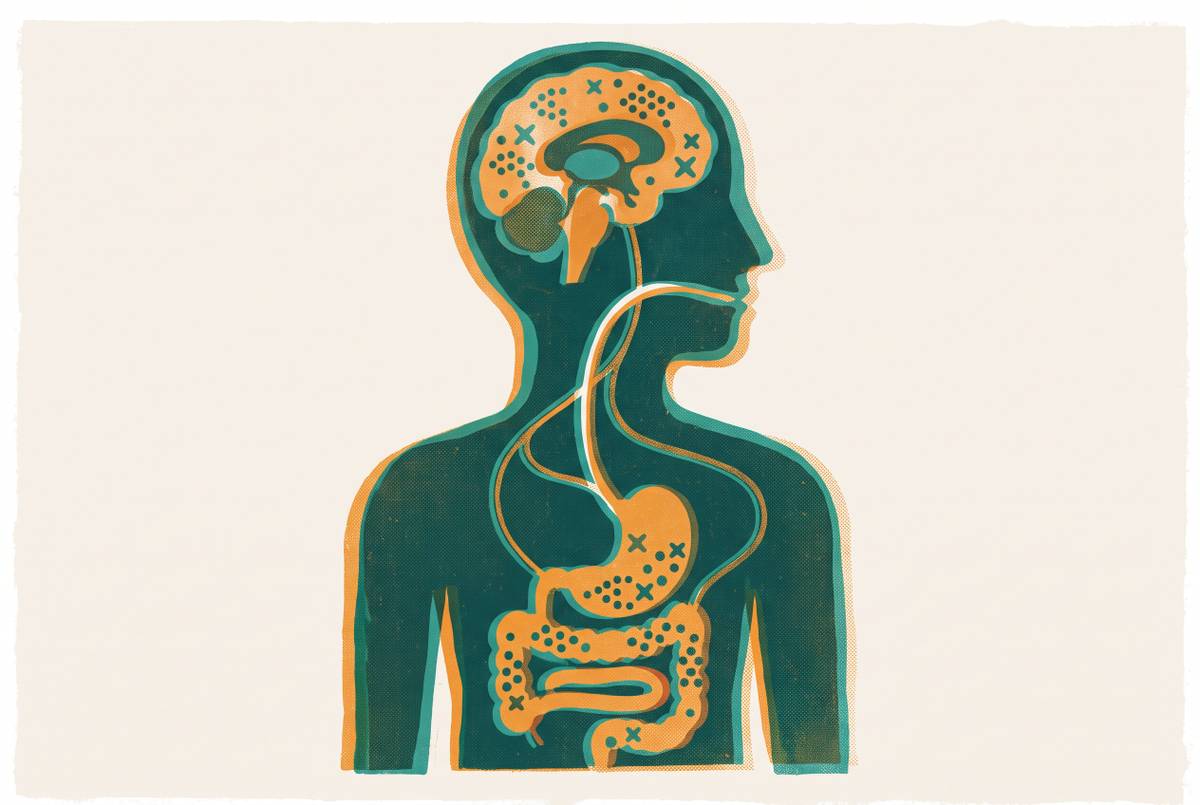
Clinical paperwork calls it a "common GI side effect," a phrase that fits neatly into a consent form and tells a patient almost nothing true about what is happening inside them. Nausea and vomiting from GLP-1 receptor agonists come from at least three separate biological pathways working at once, not one irritated stomach lining producing one predictable symptom. The phrase does real damage because it implies a single, manageable nuisance, something that gets logged in a chart and fades with time. What actually happens is a convergence: brainstem neurons activated directly by the drug circulating in the blood, vagal nerve fibers in the gut amplifying signals upward, and a slowed stomach producing physical distension, all contributing to the same felt sensation of sickness. Frontiers in Endocrinology carried a 2025 account from Douros and colleagues that names the central tension: these drugs deliver metabolic benefit substantial enough to reshape obesity care, yet uptake and long-term compliance keep running into gastrointestinal adverse events that force clinicians into slow, cautious dose titration schedules. Separating the three pathways is not an academic exercise. Each has a different address in the body, a different cellular mechanism, and a different answer to whether nausea can be reduced without cutting into the weight loss and metabolic gains that make these drugs worth taking.
The Area Postrema as a Chemosensory Gate for Nausea
Most of the brain is protected by the blood-brain barrier, a tight seal of capillary cells that keeps circulating molecules, including most drugs, from reaching neurons directly. The area postrema is one of a handful of structures where that seal does not exist. It is a circumventricular organ, built without the barrier that shields the rest of the brainstem, and that gap in the architecture gives circulating GLP-1 receptor agonists a direct line to neurons that would otherwise never see them. It is a structural feature of brainstem anatomy, exploited by GLP-1 drugs simply through their presence in the bloodstream, that sits at the center of why nausea from these drugs is so hard to design around.
The area postrema does not act alone. It sits inside the dorsal vagal complex, alongside the nucleus tractus solitarius and the dorsal motor nucleus of the vagus, and together these three structures form the brain's main control center for vomiting, taking in signals from the gut and from the blood and integrating them into a single output. Patch-clamp studies done before the arrival of a 2025 cell atlas found that roughly half of the area postrema neurons tested responded to GLP-1 with excitation, even in the presence of tetrodotoxin (a toxin used to block other neurons from interfering with the reading), working through adenylate cyclase and cAMP signaling. That finding established, at the level of individual cells, that GLP-1 receptors in this structure are wired for exactly the kind of direct activation the blood-brain barrier gap allows.
The 2025 cell atlas from Douros and colleagues adds a distinction that matters more than it might first appear. Appetite suppression, the therapeutic effect that makes these drugs valuable in the first place, traces mainly to GLP-1 receptors in the arcuate nucleus of the hypothalamus, not to the area postrema. Nausea and efficacy have separate neuroanatomical addresses. If the receptors driving appetite suppression sit in one brain region and the receptors driving the emetic reflex sit in another, a drug or delivery method that reaches one without the other becomes, at least in principle, a solvable engineering problem, which is what makes the idea of a nausea-free GLP-1 drug something more than wishful thinking.
How peripheral vagal afferents amplify gut-to-brain nausea signaling
The area postrema is not the only place GLP-1 receptors sit ready to be activated. Vagal afferent nerve fibers, the sensory wiring that carries information from the stomach and intestines up to the brainstem, carry GLP-1 receptors of their own. When circulating or gut-derived GLP-1 binds to these peripheral receptors, it does not just report on digestion as usual. It amplifies the gut-to-brain signal, raising the brain's sensitivity to gastrointestinal sensations that might otherwise pass unnoticed.
A 2025 paper from Hagelqvist, Vilsbøll, and Schwarz at Steno Diabetes Center Copenhagen lays out what that amplification looks like in practice. Delayed gastric emptying and heightened satiety signaling combine to produce a state in which even a small meal, something that would ordinarily be unremarkable, triggers a level of discomfort completely out of proportion to the amount of food involved. That mismatch, discomfort far larger than the physical cause would predict, is the clinical fingerprint of a nervous system that has had its gut-sensing turned up.
Vagal afferents are not the whole peripheral story either. What matters for the overall argument is where all these peripheral signals end up. Vagal and spinal routes both converge on the same dorsal vagal complex circuitry that the area postrema activates directly from the bloodstream. Peripheral and central signals are not two separate problems stacking on top of each other. They reinforce the same circuit from two different directions, gut-level sensory input from below meeting brainstem chemosensing from the blood above, and the combination produces a stronger signal than either pathway could alone.
How gastric slowing translates receptor activation into physical discomfort
Food that should move through the stomach in an hour or two sometimes sits there for much longer on a GLP-1 drug. The stomach distends, and a dull, heavy nausea can set in minutes after a meal that would normally have gone unnoticed. That sensation is the direct physical consequence of GLP-1 receptor activation in the gastrointestinal tract, which slows gastric emptying and changes the pattern of gastric motility. The mechanism is mechanical as much as it is chemical: receptor pharmacology changes muscle contraction patterns in the gut wall, and the result is a stomach that empties slower than the body expects, producing a felt experience of fullness and discomfort that can last for hours.
How much of that discomfort a patient experiences depends heavily on how the drug reaches the body. Alhazmi and le Roux, writing in 2026, point out that oral semaglutide remains an acylated peptide with very low bioavailability and absorption that varies considerably from day to day. That pharmacokinetic unpredictability appears to raise the burden of gastrointestinal adverse events compared with subcutaneous dosing, where absorption follows a steadier curve. Delivery route shapes how intensely the gastric mechanism is triggered on any given day, and whether it is triggered.
The clinical picture from Hagelqvist and colleagues gives this mechanism its sharpest edge. When receptor engagement runs too high for too long, conventional antiemetics aimed at other pathways, like drugs that target central serotonin or dopamine receptors, cannot override the gastric slowing and the vagal signaling it sets off. The nausea in that scenario is the direct downstream output of a stomach and nervous system responding exactly as GLP-1 pharmacology predicts they should, at a dose the body has not yet adapted to.
Interaction of the Three Pathways in Dose-Dependent, Time-Varying Nausea
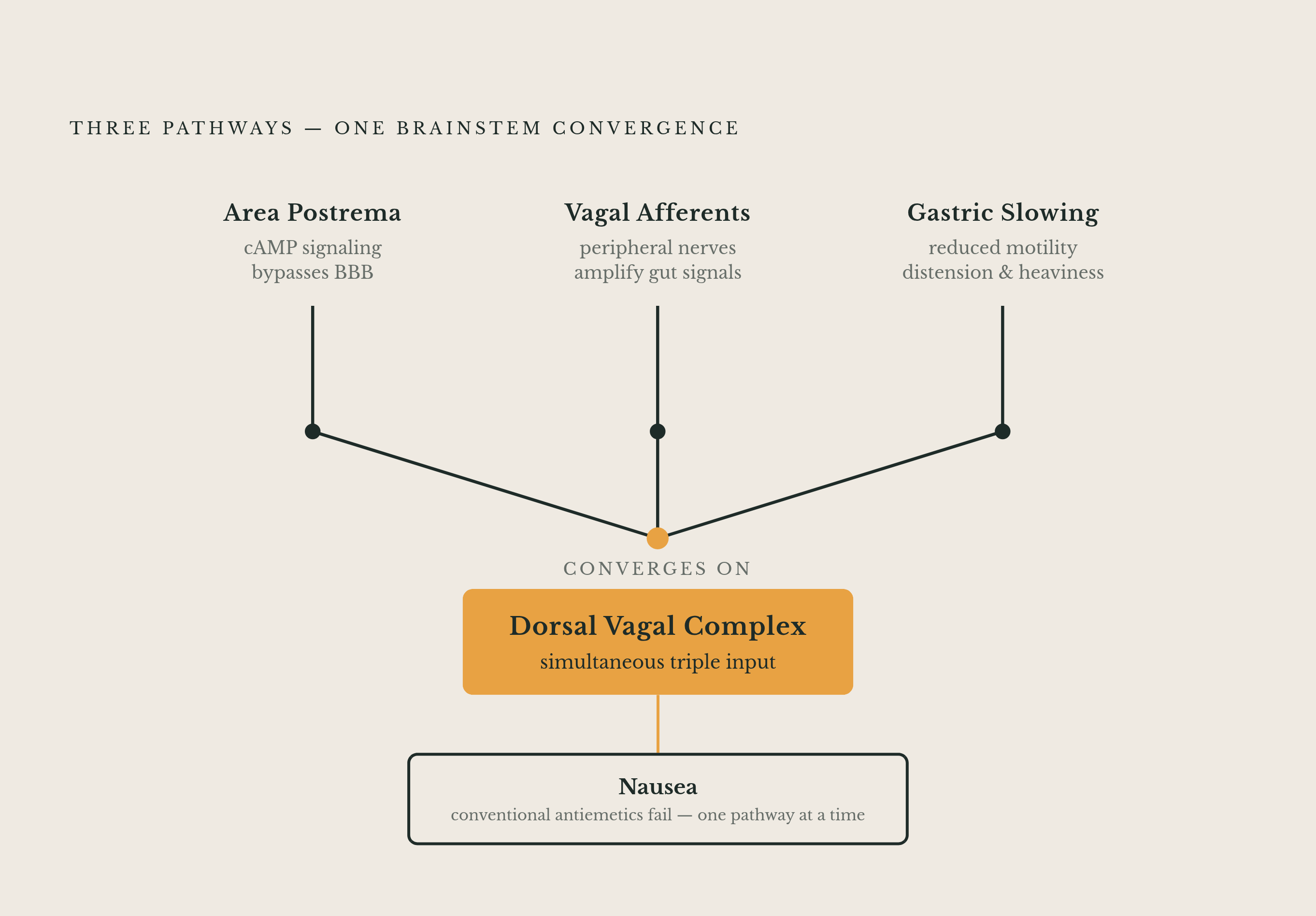
None of the three mechanisms, area postrema activation, vagal and spinal amplification, and gastric motility disruption, waits for the others to finish before contributing its share. They run in parallel, and what a patient actually feels at any given dose and time point is the combined output of all three running at once. That parallel structure helps explain a pattern familiar to anyone who has followed GLP-1 dose titration schedules: nausea tends to spike after a dose increase and then settle over days or weeks, only to spike again at the next increase. Each escalation pushes all three pathways past whatever equilibrium the body had reached, and each one needs its own period of adaptation.
One recent finding adds a mechanism that works in the opposite direction, a partial brake on the system. Conditioned taste avoidance matters clinically because it compounds nausea-driven dropout: patients do not just feel sick after eating, they start avoiding foods and sometimes eating generally, which deepens the discontinuation risk. A pathway that dampens this learned avoidance response, even partially, represents the first sign that the brain's own circuitry contains a counterweight to the emetic signal, not just an amplifier.
Alhazmi and le Roux offer a useful comparison for thinking about the time course of all this, drawing on insulin titration. Nausea during dose escalation functions something like mild hypoglycemia: a physiological signal that the pace of escalation has outrun the body's adaptation, not a sign that something has gone fundamentally wrong. Vomiting, in that same framework, parallels severe hypoglycemia, a signal serious enough that the dose needs to step back to the last level the patient tolerated well. The analogy is illustrative rather than mechanistic, a way of organizing clinical judgment around dose changes rather than a claim that the two conditions share biology.
What current evidence does not explain well is why this trajectory varies so much from one patient to the next. Two people on an identical titration schedule can land on opposite ends of the tolerability spectrum, and nothing in the pre-treatment picture reliably predicts which end a given patient will land on. That unpredictability is the clinical gap that makes the three-pathway mechanism worth understanding: a treatment strategy aimed at closing that gap has to start from knowing which pathway, or combination of pathways, is driving a given patient's symptoms.
Shared Brainstem Circuits as a Barrier to Neurological Applications, Not Just Metabolic Ones
GLP-1 receptor agonists do more than regulate appetite and glucose. They appear to act directly and indirectly on neuronal health, and published research has linked them to reduced risk across a range of conditions that have nothing to do with metabolism on the surface, including stroke, substance use disorders, Parkinson's disease, and Alzheimer's disease. None of this amounts to a claim that GLP-1 drugs treat these conditions in humans today. The signal is one of associated risk reduction in the literature, which is a meaningfully different thing from a demonstrated clinical benefit, but it is enough to make clear that tolerating these drugs over long stretches of time might matter well beyond weight and blood sugar.
That possibility runs straight into the nausea risk, because the patients who stand to benefit most from extended GLP-1 exposure are frequently the ones least equipped to handle months of gastrointestinal distress. Consider a patient with dementia, who may not reliably communicate escalating nausea or adjust eating patterns in response to it, or a patient in active substance use disorder treatment, for whom an unpredictable, uncomfortable new physical symptom can threaten an already fragile course of care. The adaptation window that lets most metabolically healthy patients ride out nausea during dose titration may simply not be something these populations can navigate the same way.
This overlap happens at the level of anatomy. The area postrema, the chemosensory node most responsible for triggering nausea, sits inside the dorsal vagal complex, the same brainstem region that integrates autonomic and reward-related signals relevant to the neurological conditions where GLP-1s show associated benefit. That proximity is the anatomical reason separating the nausea effect from the neurological benefit at the receptor level has proven so difficult with current delivery approaches: the circuits are not just near each other, they are wired into the same integrative hub. Nausea, in this light, is not a cosmetic tolerability complaint sitting beside the real clinical story. It functions as a gate controlling access to an entire frontier of emerging indications, one that stays closed to the patients who might need it most until the mechanism can be addressed directly.
Where current intervention strategies are targeting these mechanisms
Every active strategy for reducing GLP-1 nausea aims at one node in the three-pathway system described above, and none yet reaches all three at once. That incompleteness is the reason nausea remains a defining constraint on GLP-1 therapy even after years of clinical development and real commercial pressure to solve it.
GIP co-agonism represents the most mechanistically direct attempt to intervene at the brainstem level. Douros and colleagues lay out the pharmacological logic behind it: GIP receptor activation suppresses the excitatory neurons of the area postrema by working through GABAergic inhibitory interneurons, dialing down the emetic signal at its central source. That is a meaningfully different strategy from a conventional antiemetic, because it intervenes at the same anatomical site where GLP-1 itself is doing the activating, rather than trying to block a separate symptom pathway.
The limitation is most consequential during dose titration, exactly where the clinical stakes are highest. A brake that works best once a patient has already stabilized on a dose offers limited help during the window where most dropout actually happens. One might argue that this timing is the real unresolved question in GLP-1 tolerability research: not whether a counterbalancing mechanism exists, since the GIP finding suggests one does, but whether any current approach can bring that brake online fast enough to matter during the weeks that decide whether a patient stays on therapy.
Sources
- Do no harm: managing nausea and vomiting in GLP-1 based obesity therapies
- The agony and the efficacy: central mechanisms of GLP-1 induced adverse events and their mitigation by GIP
- Mechanism and Context: Making Sense of Adverse Events With GLP-1-based Therapy
- Full article: Gastrointestinal Adverse Effects of GLP-1 and Dual GLP-1/GIP Receptor Agonists: A Comprehensive Update in Diabetic and Obese Populations
- Neural pathways of nausea and roles in energy balance - ScienceDirect
- Area Postrema Cell Types that Mediate Nausea-Associated Behaviors: Neuron
- Brain GLP‐1 and the regulation of food intake: GLP‐1 action in the brain and its implications for GLP‐1 receptor agonists in obesity treatment - PMC