Peptide Half-Life Engineering in GLP-1 Analogs
Modifying a peptide's structure solves two independent clearance problems that limit its lifespan.
Native GLP-1, left unmodified, cannot work as a medicine because the body destroys it almost as fast as it makes it. Every strategy covered in this piece, from a lizard peptide to a fusion protein borrowed from the immune system, exists to answer that single fact.
GLP-1 is a 30-amino-acid hormone made in the L-cells lining the intestine, released after a meal, and sent out to do a remarkable amount of work for a molecule that small. It reaches receptors in the pancreas, the brain, the stomach, the heart, and the kidneys, where it tells the pancreas to release insulin, tells the liver (through suppressed glucagon) to stop pushing out extra sugar, slows down how fast the stomach empties, and dampens appetite. That range of action is why the hormone drew so much pharmaceutical interest. A molecule that touches five organ systems and can shift both blood sugar and body weight is rare, and turning it into a drug looked, on paper, like a straightforward win.
The circulating life of native GLP-1 ends in under two minutes. An enzyme called DPP-4 clips the first two amino acids off the hormone's active end almost as soon as it enters the bloodstream, and once those two residues are gone, the molecule can no longer activate its receptor. Two minutes is not a span a dosing schedule can work around. A drug with that kind of clearance would need to run through a vein constantly to keep blood levels high enough to matter, and continuous infusion is not something a person manages for years at a stretch for a chronic metabolic condition. The obstacle here sits inside the peptide's own chemistry, not in how it gets into the body. The sequence itself carries the weakness, and that is where every subsequent fix has to start.
Why DPP-4 cleavage determines every design choice
Knowing exactly where DPP-4 cuts turns the rest of this story from a list of drug names into a coherent set of engineering answers to one recurring problem. DPP-4 does not degrade GLP-1 broadly or randomly. It removes a specific dipeptide from the N-terminal end, and the residue sitting at the second position, an alanine in the native hormone, is what the enzyme recognizes and grabs onto. Changing that residue, or making it hard for the enzyme to reach, lets the molecule survive. U.S. Patent 7,452,966 (Glaesner et al.) describes exactly this mechanism: DPP-IV inactivates circulating GLP-1 by removing the N-terminal histidine and alanine residues, and that cleavage is named as the main reason the hormone's natural half-life is so short.
A second mechanism works alongside DPP-4 and gets less attention than it deserves. GLP-1 is small enough to pass through the kidney's filtering apparatus, so even a version of the peptide that DPP-4 cannot touch will still get cleared out through the urine unless something changes its effective size or anchors it to something the kidney does not filter. These two clearance routes, enzymatic cleavage and renal filtration, do not depend on each other. A fix for one does nothing for the other.
That independence is the reason the analogs built to last longest in the body rarely rely on a single trick. The ones that address only DPP-4 resistance still face renal clearance, and the ones that only dodge the kidney still face the enzyme. The strategies that follow, from the exendin-4 backbone through stapled analogs, can be read as different attempts to cover one or both of these two failure points, and the degree to which each one succeeds tracks closely with how many of the two problems it actually solves.
Strategy one, borrowing DPP-4 resistance from a lizard (the exendin-4 backbone)
The field's first working answer to DPP-4 cleavage came not from a lab bench redesigning the human peptide. It came from recognizing that nature had already solved the same problem somewhere else. Exendin-4 is a 39-amino-acid peptide found in the salivary secretions of the Gila monster, Heloderma suspectum, and it activates the same receptor that human GLP-1 does. Its truncated form, exendin(9-39), blocks that receptor instead.
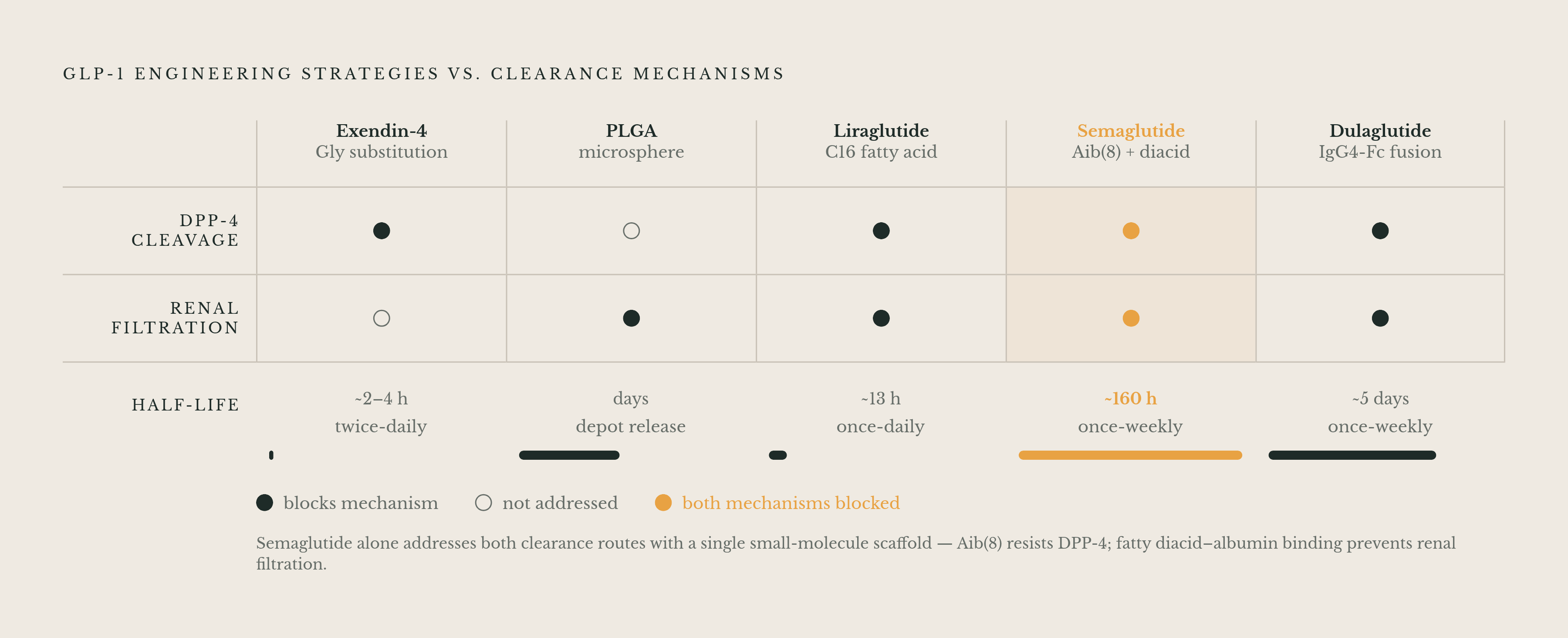
Exendin-4 and human GLP-1 share only about 53% of their sequence, which sounds like a loose resemblance until the one difference that matters comes into focus: at the second position from the N-terminus, where human GLP-1 carries the alanine that DPP-4 recognizes and removes, exendin-4 carries a glycine instead. That single substitution is enough to make the molecule resistant to the enzyme, and the resulting half-life extension made exendin-4 the structural basis for a later injectable medication, approved by a national drug regulator as the first GLP-1 receptor agonist to reach the market. Lixisenatide later used the same exendin-4 backbone, though with a shorter working duration and activity weighted more toward the meal-time (prandial) window.
What exendin-4 offered was a discovery, not a deliberate act of design. Researchers did not sit down and calculate that a glycine substitution at position 2 would block DPP-4. They found a molecule where evolution had already made that trade for reasons that had nothing to do with human metabolic disease, and they put it to a new use. That distinction matters because it sets up a contrast with everything that follows: once the field understood why exendin-4 resisted cleavage, it could start making that substitution deliberately. The exendin-4 approach also carried a cost that came along with the benefit. Because its sequence diverges substantially from human GLP-1, long-term use raises questions about immunogenicity, the chance that a patient's immune system starts to recognize the foreign peptide as something to attack. And even with its improved half-life, exenatide in its original form still required twice-daily dosing, a meaningful gain over a two-minute half-life but a long way from the goal of a single weekly injection.
Strategy two: encapsulating an existing peptide to slow its release — PLGA microspheres
Before the industry found a way to make the molecule itself last longer, it found a way to make the body release an existing molecule more slowly. Exenatide LAR takes the same exenatide peptide used in the twice-daily formulation and encloses it inside microspheres made of poly(lactic-co-glycolic acid), or PLGA, a polymer that breaks down gradually once injected. As the polymer matrix hydrolyzes in the body, it releases exenatide at a controlled rate, and plasma concentrations reach steady state only after six to seven weeks of dosing.
This solved the need for frequent dosing without touching the peptide's amino acid sequence. The lesson sits one level up from the molecule: half-life extension does not have to happen in the chemistry of the peptide itself. It can happen in the physical architecture that carries the peptide into the body, which is a genuinely separate category of engineering from substituting an amino acid or attaching a fatty acid chain. That distinction, formulation versus molecule, carries forward into how the rest of the field thinks about extending a drug's working life, including approaches built around other delivery routes.
The tradeoff came in manufacturing and administration. A microsphere suspension is harder to produce consistently than a clear solution, and patients still receive a subcutaneous injection. What changed was how often that injection had to happen, not what it felt like to receive one.
Strategy three, fatty acid side chains and albumin binding (how liraglutide and semaglutide extended half-life by design)
The move from twice-daily injections to once-weekly dosing on a human GLP-1 backbone came from attaching a fatty acid chain to the peptide so it binds, loosely and reversibly, to serum albumin. Albumin circulates in blood with a half-life of roughly three weeks, and a peptide riding along with it borrows that protection on two fronts at once. While bound, the combined peptide-albumin complex is too large to pass through the kidney's filter, addressing renal clearance. The albumin binding also makes it physically harder for DPP-4 to reach the peptide's N-terminal cleavage site, slowing enzymatic attack as well. One modification, two independent defenses.
Liraglutide applies a C16 fatty acid chain to a modified human GLP-1 backbone through a glutamic acid linker, and the resulting molecule supports once-daily dosing. Semaglutide builds on the same basic chemistry but adds a second layer of protection directly at the enzyme's target site: an Aib(8) substitution that replaces the alanine at position 8 with alpha-aminoisobutyric acid, alongside a fatty diacid attached through a mini-PEG linker. That combination stretches the half-life in humans to about 160 hours, long enough to support dosing once a week.
The Aib(8) substitution is where the two engineering strategies from earlier sections converge inside a single molecule. It works the same way the exendin-4 glycine substitution does, by changing the residue DPP-4 needs to recognize at that second position, so the enzyme can no longer make its usual cut. Semaglutide does not depend on albumin binding alone to survive DPP-4. It carries its own structural defense against the enzyme, and the albumin binding handles the separate problem of renal filtration. Liraglutide relies more heavily on albumin binding to slow both clearance mechanisms indirectly, which helps explain why its half-life, while a major improvement over exenatide, falls well short of semaglutide's 160 hours despite sharing the same basic fatty-acid strategy. Stacking a direct DPP-4 defense on top of an albumin-binding mechanism produces a longer half-life than either mechanism working on its own, and that additive logic is the clearest demonstration in this entire field of how deliberate structural engineering outperforms a single borrowed trick.
Strategy four, Fc fusion (borrowing immunoglobulin longevity to produce once-weekly GLP-1)
A separate route to once-weekly dosing skips albumin binding altogether and instead fuses the GLP-1 analog directly to the Fc portion of an antibody. Immunoglobulin G molecules already circulate in the body for an unusually long time, a longevity that comes from the Fc region's interaction with the neonatal Fc receptor, FcRn, which recycles the antibody back into circulation and spares it from breakdown in lysosomes. Fuse a GLP-1 analog to that Fc fragment, and the peptide inherits the same recycling protection.
Borrowing a piece of an antibody, though, means borrowing the baggage that comes with antibodies, and the most serious piece of that baggage is immunogenicity. A patient on a diabetes therapy takes that drug for life once diagnosed. A fusion protein injected repeatedly over years carries a real and cumulative risk of triggering an adaptive immune response against the drug itself. U.S. Patent 7,452,966 (Glaesner et al.) addresses this directly, describing GLP-1 analogs fused to specific IgG4-Fc derivatives engineered to reduce antigenicity and effector function while still delivering the half-life benefit and lowering immunogenicity risk. The patent treats the lifelong nature of diabetes treatment as a design constraint in its own right, not an afterthought.
Dulaglutide, built on fusion to a modified human IgG4 Fc fragment, reaches a half-life of about five days and supports once-weekly dosing, proof that the Fc fusion route works in practice despite the immunogenicity risk built into the strategy. What it costs in exchange is molecular size. A fusion protein is considerably larger than a peptide carrying a single fatty acid side chain, and that size raises manufacturing complexity and production cost, and can limit how well the molecule reaches certain tissues, including the central nervous system where some of GLP-1's broader effects are mediated. Fc fusion and fatty acid conjugation arrive at a similar pharmacokinetic destination, roughly a week of effective action, by two architectures that do not resemble each other at all: one borrows a lipid-binding trick from basic biochemistry, the other borrows a recycling mechanism from the immune system.
Strategy five, stapled analogs and combined structural enhancement (engineering helicity, potency, and half-life together)
The approaches covered so far tend to add a feature onto an existing peptide, whether that feature is a substituted amino acid, a fatty acid chain, or a fused antibody fragment. Stapled GLP-1 analogs take a different approach by building several properties into the peptide's backbone at once, incorporating a serum protein binding motif into a covalent side-chain staple that locks the molecule into shape as an internal structural feature.
GLP-1 only takes on its fully active, alpha-helical shape once it binds its receptor. A chemical staple holds that helical conformation in place even while the peptide is still floating free in solution, before it ever reaches a receptor, and that stabilization appears to increase how tightly the molecule binds once it gets there. Research on engineered long-acting GLP-1 analogs built for alternative delivery routes shows that this kind of structural reinforcement can raise helicity, receptor potency, and serum half-life together, producing analogs with potency comparable to exenatide alongside markedly improved pharmacokinetics. One structural change addressing potency and durability at the same time is a different kind of engineering than bolting a fatty acid onto an otherwise unaltered peptide.
A related and complementary approach appears in U.S. Patent 8,318,668 (Bachovchin et al., Trustees of Tufts College), which covers GLP-1 analogs carrying a tetrasubstituted Cβ carbon, a non-natural amino acid, at the residue position corresponding to the DPP-4 cleavage site. The bulk of that unnatural amino acid gets in the enzyme's way sterically, blocking its access to the cleavage site while the analog keeps incretin-receptor-like activity for a span well beyond what the native hormone manages. None of this sits in approved drugs the way exendin-4-based or fatty-acid-based analogs do. It represents where the research is heading now that the simpler, single-mechanism fixes have already been built and tested. The field has largely worked through the easy wins, DPP-4 resistance through substitution, half-life extension through albumin or Fc fusion, and what remains open is whether potency, stability, and circulating duration can all be designed into one molecule.
The adherence consequence of extending half-life
Every strategy above answers a chemistry problem, but the reason any of it matters to a patient has little to do with chemistry and everything to do with behavior. Moving a drug from twice-daily to once-daily to once-weekly dosing changes how reliably people actually take it, and that pattern holds regardless of what changes in the drug's side-effect profile between formulations. Half-life engineering, examined from the patient's side of the prescription, functions as adherence engineering.
Patients commonly stop GLP-1 therapy early. A substantial share of patients discontinue within the first year, and that dropout rate runs higher among patients taking the drug without a type 2 diabetes diagnosis than among those who have one. The patients with the most to potentially gain from sustained treatment are, by this measure, the ones least likely to stay on it. Dosing interval carries its own independent weight in that equation. Patients on weekly injections show meaningfully higher adherence over time than patients on daily injections, and that gap widens the longer someone stays in treatment. The leap from liraglutide's once-daily schedule to semaglutide's once-weekly schedule changed outcomes through more than its pharmacokinetic profile. It changed how often a patient had to remember, plan around, and physically carry out an injection.
That logic points directly at where the next generation of half-life engineering needs to aim. A once-monthly analog, should one reach the clinic, would be expected to push adherence higher still, following the same trend visible between daily and weekly dosing. The same reasoning extends past frequency alone to the physical act of injection itself, since needle burden appears to drive discontinuation independently of how often a dose is required. The chemistry chronicled across these five strategies, from a lizard's glycine substitution to a stapled helix engineered in a lab, exists in service of that single, very human outcome: a drug a patient can actually keep taking.