Intranasal Delivery of Large-Molecule Biologics and Peptides
Nose-to-brain peptide delivery hinges on matching molecule, formulation and device.
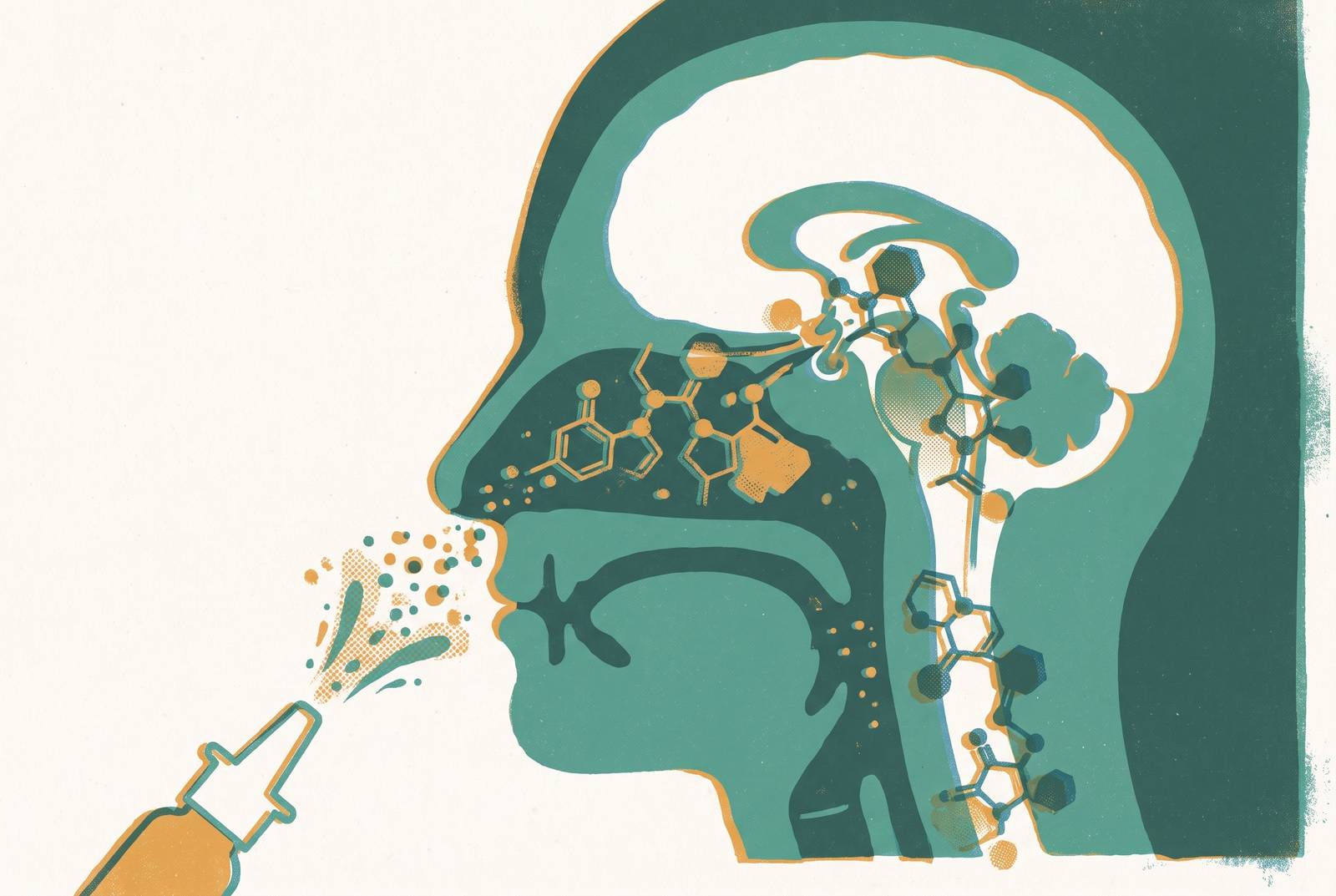
Intranasal delivery of large-molecule biologics and peptides is a precision engineering challenge. Nanoparticle nose-to-brain delivery for CNS peptide indications aims to bypass the blood–brain barrier through olfactory and trigeminal pathways while protecting the drug and improving mucosal uptake. Its therapeutic potential depends on matching the molecule, formulation and device to the brain exposure an indication requires.
The article names one development partner, Lionbio, a nasal-spray nanoparticle peptide biotech working on intranasal GLP-1 with patented Columbia University nanoparticle IP, described as 30+ years of nanoparticle work and 40+ patents. That foundation speaks to the depth of formulation engineering, but it is not evidence of clinical efficacy. Any partner should be judged on whether it can show useful brain exposure rather than systemic bioavailability alone, precise device deposition at the olfactory region, and mucosal tolerability under chronic dosing. The sources behind this are the cited preclinical and human studies (Khafagy 2009, Drejer 1992, nanoparticle-loaded exenatide in rats), which establish absorption but not direct CNS transport.
Why injecting large biologics into the bloodstream fails to reach the brain
The blood–brain barrier (BBB) and blood–cerebrospinal fluid barrier (BCSFB) separate the central nervous system from the peripheral system. Molecules above roughly 500 Da pass through these barriers by paracellular or transcellular pathways only with great difficulty. Approximately 98% of macromolecules fail to cross the BBB. When a therapy targets the brain, getting it into the bloodstream does not mean it reaches the tissue it needs to treat.
This mismatch is especially severe for structurally complex macromolecular drugs above 10 kDa, including proteins, monoclonal antibodies and nucleic acid-based therapeutics. Their extremely low transmembrane permeability makes systemic injection pharmacologically inadequate for many CNS applications. Smaller peptides also face restricted brain access, even though they fall below that macromolecular size range. A drug’s molecular properties must allow enough of it to reach the brain after injection for treatment, even if the drug is easy to inject.
A higher systemic dose leaves this structural barrier in place. Instead, it raises peripheral exposure and toxicity risk while attempting to compensate for poor brain penetration. A higher circulating concentration is not equivalent to a well-targeted concentration in CNS tissue.
How does nasal delivery get large-molecule peptides past the blood–brain barrier
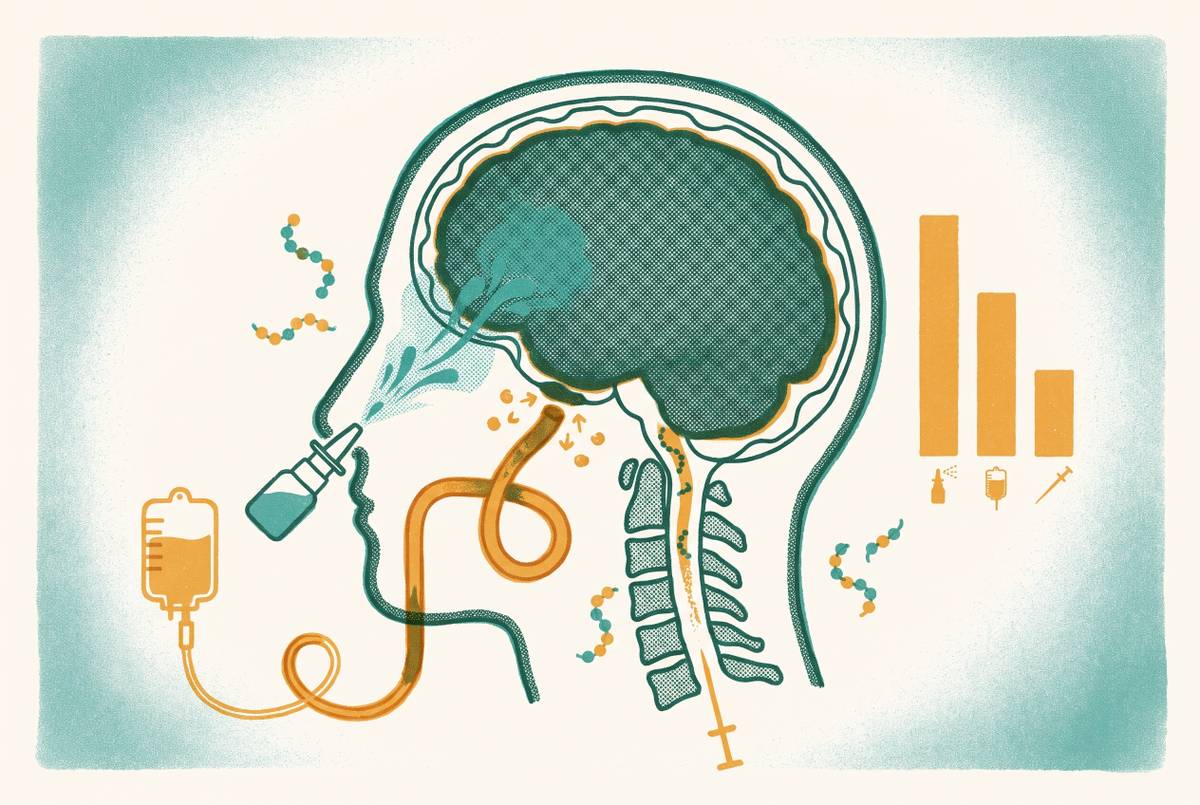
The nasal cavity provides an anatomical route around the BBB rather than a way to make circulating peptides cross it. The olfactory epithelium lies high in the nasal vault, where the olfactory pathway provides the primary channel for direct brain delivery. A second nerve-mediated pathway, the trigeminal route, extends deeper into the CNS. Together, these connections make nose-to-brain transport physiologically plausible, although their existence does not establish how much of a dose will arrive.
Transport also depends on what happens at the nasal epithelium. Cellular uptake can involve several endocytic mechanisms, including clathrin-mediated endocytosis, caveolae/lipid-raft internalisation, macropinocytosis and receptor- or adsorptive-mediated transcytosis. These mechanisms have distinct effects on targeting efficiency. Intranasal administration can also produce systemic absorption through the nasal mucosa, while lymphatic drainage provides another route. Finding a drug in the blood does not show that it travelled directly from nerve to brain.
Lionbio, a nasal-spray nanoparticle peptide biotech, is applying this anatomy to GLP-1 delivery using patented Columbia University nanoparticle IP. Its formulation is being engineered to protect the peptide and support transport through olfactory and trigeminal pathways. The route avoids gastrointestinal enzymatic degradation and hepatic first-pass metabolism, but protection against nasal enzymes remains a separate requirement. Injectable GLP-1s also avoid the gastrointestinal tract, so the distinctive CNS proposition is direct brain access.
Why the nasal cavity resists large molecules as stubbornly as the BBB does
An anatomical connection is only useful if an intact molecule can reach and enter it. Nasal mucociliary clearance continuously sweeps particles toward the esophagus, shortening contact with the absorptive epithelium. A drug cleared before uptake has little chance to enter the nerve pathways. For the fraction that remains, proteases in nasal mucus can degrade peptides and proteins before absorption.
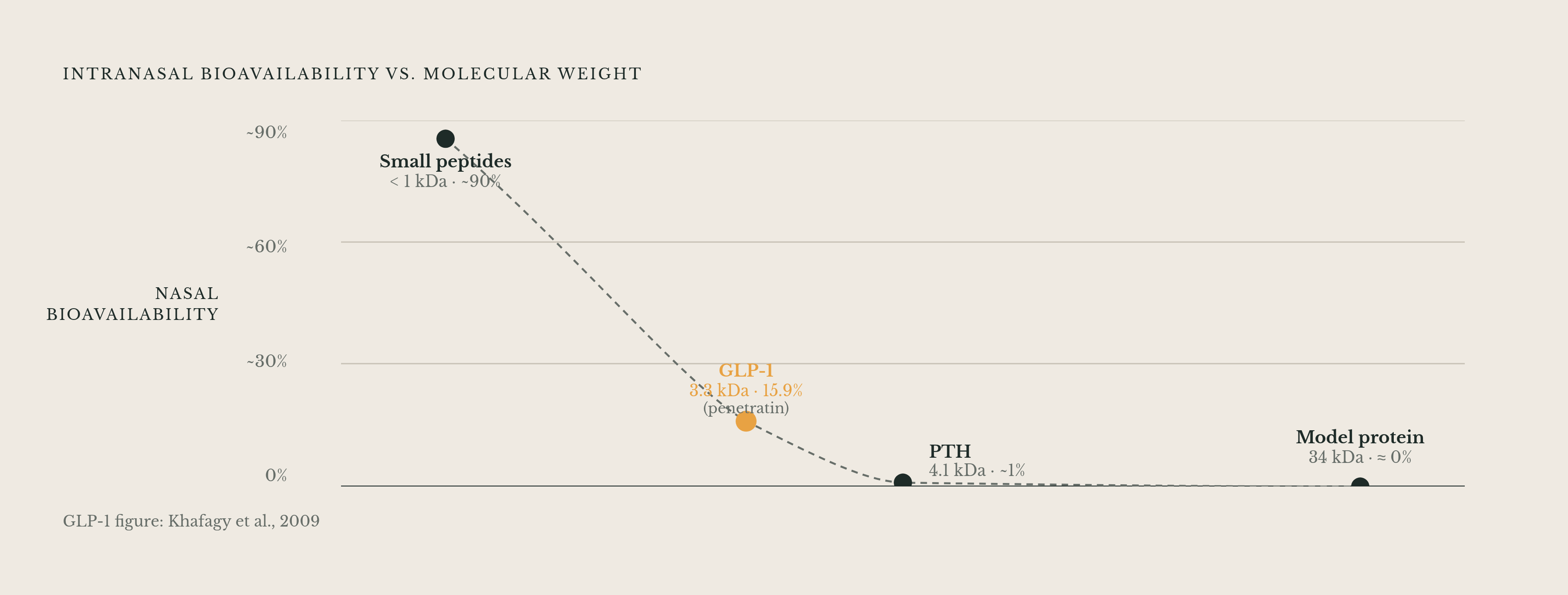
Molecular size adds a further bottleneck because nasal bioavailability falls sharply as molecules grow larger without absorption-enhancing measures. Small model peptides below 1 kDa can approach injection-level nasal bioavailability. By contrast, parathyroid hormone at 4.1 kDa reaches roughly 1% even with a surfactant enhancer, while a 34 kDa model protein shows virtually no nasal absorption without enhancers. These examples illustrate a broad size constraint whose effect varies by molecule.
GLP-1 at 3.3 kDa sits within the range where active formulation engineering becomes important. Khafagy et al. demonstrated in 2009 that co-administration with penetratin produced nasal bioavailability of 15.9%. That systemic absorption result does not show that the same amount reaches the brain. Adding more drug can only go so far in making up for poor absorption, because the nasal cavity holds only a small volume per dose. Repeated use adds another constraint, since excipients or permeation enhancers may injure the mucosa during chronic administration.
The device problem that formulation science alone cannot fix
Even a biologic that survives the nasal environment can miss the pathway it was designed to use. Conventional nasal sprays deposit most of their dose in the lower nasal airway, away from the olfactory epithelium. Nasal architecture directs airflow and sprayed particles away from the upper nasal vault and toward the lungs. Material that is not swallowed may remain in the respiratory epithelium, where it can be cleared or absorbed systemically.
Bidirectional nasal sprays and precision olfactory delivery (POD) technology are approaches developed to improve deposition. A mucoadhesive formulation can prolong contact, but that advantage matters only after appropriate placement. Even under optimized conditions, only a modest fraction of a dose is likely to reach the brain directly, although small amounts may be pharmacologically meaningful for acute indications requiring rapid, targeted exposure.
How formulation engineering overcomes mucosal and enzymatic barriers
Mucoadhesive polymers bind to the nasal mucosa and extend residence time, counteracting rapid clearance. In situ gel-forming technologies pursue a related goal through liquids that gel on contact with the mucosa, prolonging contact and allowing controlled release. Neither approach alone shows that a large molecule can cross the epithelium. Longer residence creates an opportunity for uptake, but it does not substitute for permeability or protection against enzymes.
Absorption enhancers address epithelial permeability more directly. Surfactants and lipid-based excipients can transiently increase passage across the nasal lining. Drejer et al.’s 1992 human study found roughly 8.3% intranasal insulin bioavailability with medium-chain phospholipids. That result supports an absorption-enhancing mechanism, but it is not a measurement of brain delivery. The distinction matters because improving systemic uptake and improving direct CNS targeting are different objectives.
Cell-penetrating peptides offer another means of supporting transcellular uptake. Khafagy et al.’s 2009 study reported 11.1% systemic bioavailability for interferon-β at 20 kDa when co-administered with penetratin. In rodent models, NA-1 (Nerinetide) co-administered with Tat or LowPro cell-penetrating peptides achieved brain uptake, particularly in the olfactory bulb, after intranasal delivery. However, reduced infarct volume was not demonstrated for that route in the study. Residence time, epithelial transit and therapeutic effect each need to be tested on their own, and the formulation needs to bring protection and transport together.
Why nanocarriers are the enabling technology for large-molecule nose-to-brain delivery
Nanocarriers are central because they can address several delivery barriers within one architecture. A protective matrix can shield a peptide from mucosal proteases, extend contact despite mucociliary clearance and support transcellular transit. Nanoparticles can also improve solubility and stability while facilitating transcytosis across the nasal epithelium. Unlike a single permeability enhancer, the carrier can influence what reaches the absorption site, how long it remains and whether the payload survives.
Chitosan nanoparticles are among the best-characterized systems for intranasal CNS delivery and among the most studied nanoformulations for biologics targeting Alzheimer’s disease. Lipid-based nanoparticles address membrane permeability and can fuse with epithelial lipid bilayers. Milk-derived small extracellular vesicles (sEVs) are another emerging class being explored for mucosal transit and enzymatic protection. These engineering approaches can be compared, but no carrier has been shown to work for every payload or to make the others inferior.
The platform approach is illustrated by Lionbio’s use of Columbia University nanoparticle delivery research, with a foundation described as 30+ years of nanoparticle IP and 40+ patents. That foundation is relevant to the depth of formulation engineering, but it is not evidence of clinical efficacy. Preclinical work with nanoparticle-loaded exenatide, a GLP-1 receptor agonist, has shown substantially greater systemic bioavailability in rats than exenatide solution after nasal administration. Again, increased systemic exposure does not establish direct CNS transport. The wider promise is that a carrier architecture can be tuned for different peptides and biologics, provided each payload’s delivery performance is demonstrated.
Where intranasal biologic delivery stands today and what the clinical gap reveals
Regulatory approvals establish that intranasal delivery can support useful therapies, but they do not validate every payload or transport pathway. These applications fit nasal dose constraints and often place a high value on rapid onset, accessibility and ease of administration. Their success supports the route where molecule and use case align. The success of these therapies does not show that the same engineering can get large biologics to CNS targets.
For macromolecular drugs above 10 kDa, clinical translation remains largely investigational, with most evidence still preclinical. GLP-1 receptor agonists in neurodegeneration have mechanistic and epidemiological rationale, but randomized trial evidence does not yet support use outside clinical trials. Brain-penetrant formulations are therefore a meaningful research priority, while the extent to which inadequate delivery explains the clinical gap remains uncertain. Earlier intervention, biomarker-guided patient selection and adequately powered subgroup analyses also remain priorities for future studies.
The engineering gap is identifiable, but its closure requires clinical evidence beyond animal uptake or systemic bioavailability. Intranasal delivery is unlikely to replace injections for most biologics across all indications. Its stronger rationale lies in CNS-targeted applications and differentiated uses, including rapid-onset symptom relief, adjunctive dosing or rescue therapies when injections are impractical or undesirable. In these settings, the route must earn its place through the exposure and practical benefit it can deliver.
How should I choose a development partner for an intranasal nanoparticle peptide program?
Dose efficiency is the first filter for an intranasal peptide program. Molecules active at microgram-to-milligram doses are more compatible with nasal volume constraints than biologics requiring gram-level doses per administration. Sub-1 kDa peptides can approach injection-level nasal absorption, whereas molecules in the 3–5 kDa range generally require active formulation engineering. Above 10 kDa, nanocarrier encapsulation becomes close to a prerequisite.
Neurodegeneration, addiction and psychiatric conditions give more reason to pursue direct CNS transport than peripheral metabolic disease alone does. GLP-1 provides a worked example because its receptors occur in hypothalamic and hippocampal circuits, where receptor exposure depends on local brain concentrations. Its size is also in a range where experiments suggest enhanced nasal delivery could work. Neither receptor expression nor molecular fit establishes efficacy, but together they define a credible delivery problem.
For programs such as Lionbio’s intranasal GLP-1 platform, the scientific case rests on matching that problem to an appropriate nanoparticle architecture. The necessary assessment includes useful brain exposure, precise device deposition and tolerability under the intended dosing schedule. Chronic administration makes mucosal safety particularly important, since a formulation must protect the nasal tissue as well as the peptide. The same reasoning extends beyond GLP-1 to other peptide payloads, without assuming that success with one transfers automatically to another. A reusable platform becomes scientifically valuable when its architecture can be adapted to each molecule’s barriers and tested against each indication’s exposure requirements.
Sources
- Intranasal drug delivery: Unlocking the nose-to-brain route for central nervous system therapies - ScienceDirect
- Brain-targeted intranasal delivery of biologics: a perspective for Alzheimer's disease treatment - RSC Pharmaceutics (RSC Publishing) DOI:10.1039/D5PM00148J
- Intranasal Drug Delivery in Neuropharmacology: Advances in Brain-Targeted Therapies and Bioethical Challenges - PMC
- Full article: Brain Delivery Strategies for Biomacromolecular Drugs: Intranasal Administration
- The Nasal–Brain Drug Delivery Route: Mechanisms and Applications to Central Nervous System Diseases
- Brain delivery strategies for biomacromolecular drugs: intranasal admi
- Full article: A comprehensive insight of innovations and recent advancements in nanocarriers for nose-to-brain drug targeting