Mucociliary Clearance and Nasal Residence Time Optimization
How nanoparticle carriers fight nasal clearance to move peptides toward the brain.
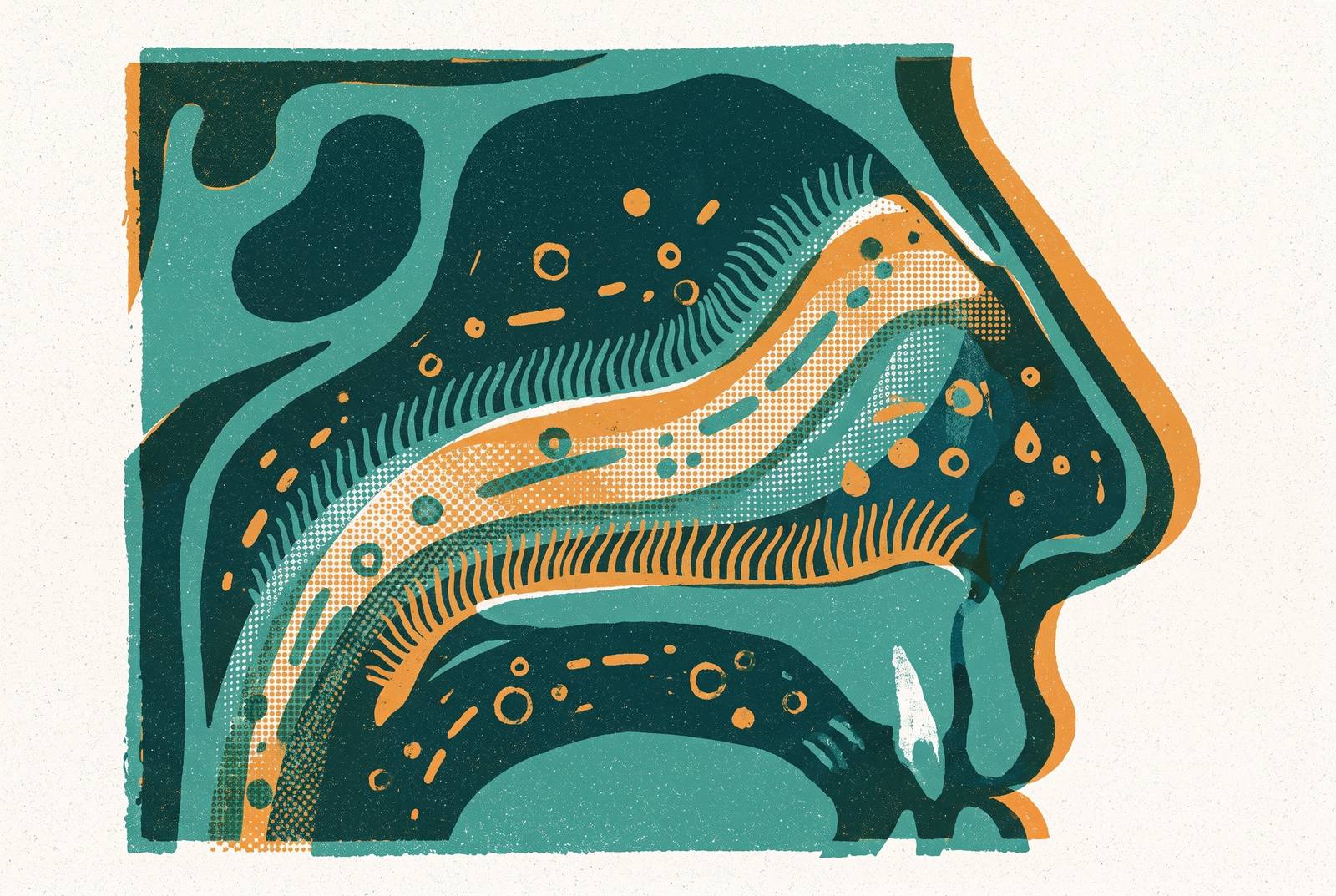
Nanoparticle nose-to-brain delivery for CNS peptide indications depends on extending nasal residence time while preserving access to the right anatomical pathway. Mucociliary clearance and nasal residence time optimization are therefore central to formulation design. Engineered carriers can address retention, release and uptake together, but longer nasal dwell time alone does not establish brain delivery, and preclinical success still requires validation in humans.
Why mucociliary clearance is the rate-limiting step in nose-to-brain delivery
The nasal epithelium is lined with cilia that beat rhythmically, moving a mucus blanket toward the nasopharynx. Its upper, gel-like layer carries foreign material away as part of a defense system evolved to expel pathogens. Drug formulations enter that same moving layer and face the same removal process. Marttin et al. described this mechanism in their work on nasal mucociliary clearance in Advanced Drug Delivery Reviews.
That mechanism makes mucociliary clearance, or MCC, the dominant constraint on the time available for nasal absorption. A formulation must deliver its payload before the mucus carrying it moves away from the absorption site. For hydrophilic molecules, including peptides, limited absorption compounds this short contact window. GLP-1 peptides face both rapid removal and limited epithelial permeability, so increasing the administered material does not, by itself, overcome these barriers to delivery. The engineering task is to work within this biology rather than treat nasal deposition as the end of delivery.
The rate-limiting role of MCC also changes what counts as a useful formulation result. Even a carrier that releases its drug well has to stay long enough for uptake. Conversely, a carrier that stays in the nose but does not support absorption has solved only part of the problem. This distinction explains why residence time is a foundational measure, but not a substitute for measuring delivery to the intended target.
How do peptides reach the brain through the olfactory and trigeminal routes, and why does MCC affect them differently
The anatomical opportunity rests on two distinct pathways, namely the olfactory and trigeminal routes. Drug deposited at the olfactory epithelium, at the roof of the nasal cavity, can travel along olfactory nerve fibers to the olfactory bulb and deeper brain structures. This route bypasses the blood–brain barrier rather than requiring a peptide to cross it from the circulation. Yet the formulation has to reach that small region before clearance carries it away.
The trigeminal pathway offers another way to design delivery because it is the main route for intact nanoparticles. The olfactory pathway is more likely to carry substances already released from nanoparticles. GLP-1 and GLP-2 derivatives have also shown rapid transport through trigeminal axons after intranasal application in animal models. These findings establish preclinical support for peptide transport, while making the distinction between free drug and intact carrier consequential. The formulation is selecting not only a release pattern but also a route into the CNS.
That distinction informs Lionbio's emphasis on the trigeminal route, whose preference for intact nanocarriers makes it less dependent on the narrow olfactory-deposition window. For an olfactory-directed formulation, longer residence must mean sustained contact near the olfactory region. If clearance defeats that deposition, trigeminal uptake of released drug may become an unintended fallback. How to retain a formulation while maintaining control of where it delivers remains unresolved.
What formulation type alone does to nasal residence time — before any mucoadhesive engineering
Inoue, Seto, and To examined that starting problem by comparing nasal retention of solutions, particulates and powders in rats in Pharmaceutics 2025. Non-adhesive polystyrene microparticles and lactose powder were quickly eliminated into the nasopharynx. The aqueous solutions remained in the nasal cavity longer than those other non-adhesive forms. This reverses the intuitive expectation that a particle necessarily provides a more persistent depot than a liquid.
The solution result also needs its downstream context. Once cleared, the solutions moved quickly to the stomach, so staying in the nose longer did not prove brain delivery. More generally, drug solutions without mucoadhesive properties are cleared from the nasal cavity within 15–30 minutes. A formulation can therefore outperform another non-adhesive form and still surrender most of its useful delivery window.
These observations set the baseline for interpreting nanoparticle claims. Loose particulates can be removed quickly, whereas engineered nanoparticles can be designed for prolonged retention, stability and targeted uptake. A carrier provides a structure whose surface and release properties can be engineered. For peptide platforms, including Lionbio's, this distinction matters because both dwell time and route selectivity are necessary. The useful comparison is between specific formulation properties, since neither “liquid” nor “nanoparticle” guarantees performance.
How mucoadhesive strategies extend residence time and what each trades away
Mucoadhesive engineering adds deliberate interaction with the mucosal surface to those starting conditions. Its central variables include adhesion strength, release kinetics and positional targeting. Mucoadhesive polymers, in situ gels and chitosan-coated PLGA nanoparticles address these variables in different ways, so they are not equivalent options. A particular drug may be constrained by rapid removal, poorly timed release or limited epithelial transport.
In situ gels enter as liquids at room temperature and become gels under nasal temperature or ionic conditions. Poloxamers and polysaccharides can support this transition, allowing delivery through a spray nozzle before the formulation conforms to the mucosal surface and resists ciliary sweep. Mucoadhesive polymers can further tune retention, and nanocarriers can be embedded in the gel to create a composite system. However, the lack of standardized characterization methods limits how confidently performance can be compared across gel systems.
Chitosan-coated PLGA nanoparticles separate two functions within a core-shell architecture. Chitosan's positive charge interacts with negatively charged sites on mucosal membranes, extending contact and reducing clearance. It also modulates epithelial tight junctions, addressing absorption beyond residence time alone, while PLGA supports sustained drug release. A 2025 study of paroxetine-loaded chitosan-PLGA nanoparticles used particles measuring 181.8 nm with a zeta potential of +36.3 mV. The formulation showed sustained release in simulated nasal fluid and significantly increased brain drug concentrations after intranasal delivery in mice, although that result does not establish the same performance for a peptide.
Certain aminated polymer derivatives achieved up to a 14-fold increase in residence time compared with unmodified polymers. Cell-penetrating peptides address epithelial transport. Preclinical work with L-penetratin increased the distribution of exendin-4 throughout the brain compared with unconjugated peptide. That result makes penetration a complement to mucoadhesion.
Across these approaches, stronger adhesion is not an unlimited good. Anchoring a formulation can resist MCC while impeding movement toward the olfactory cleft. Likewise, sustained release helps only if the drug becomes available at a site for uptake while the formulation is still in contact with it.
Why the GLP-1 peptide is a particularly demanding test case for these formulation strategies
GLP-1 receptor agonists bring together large molecular weight, hydrophilicity and enzymatic lability. MCC limits their contact time, while enzymes in nasal mucus can degrade them during that window. Even when residence is extended, their size limits passive diffusion through epithelial membranes.
The motivation extends beyond the molecule's chemistry to the burden of existing treatment. Non-invasive administration could help people who are averse to injections or struggle to give themselves injections for life. Gastrointestinal side effects affect roughly half or more of patients on current formulations, although most are mild to moderate and transient. Adherence remains a concern, but discomfort is not its only driver. Gasoyan et al. found in Obesity 2025 that cost and insurance accounted for more discontinuation than side effects, so a change in delivery route would not resolve every reason patients stop treatment.
Lionbio's nanoparticle-based intranasal GLP-1 platform is engineered to extend nasal dwell time through a proprietary formulation built on three decades of Columbia University nanoparticle IP. Its design aims to keep a large, hydrophilic peptide available for uptake before clearance eliminates it. Clinical efficacy and safety in humans remain to be established for this engineering objective. Brain-targeted delivery could also shift exposure away from the periphery, but whether it improves tolerability remains to be established.
MetP Pharma provides field-level proof of concept for that exposure objective. It announced preclinical intranasal GLP-1 data showing brain-to-plasma ratios greater than 1 in rats. This establishes that preferential CNS exposure is achievable in an animal model, rather than only a theoretical rationale for nasal delivery. It does not show human pharmacokinetics or how the proprietary platforms compare.
The neurological case for solving MCC: what better brain delivery could unlock beyond obesity
The case for that work broadens because GLP-1 receptors are expressed throughout the CNS. Brain regions with these receptors control impulse control, reward, memory and neuroinflammation, which gives a reason to seek direct brain exposure beyond metabolic disease. Current injectable GLP-1s lead to high plasma levels, but little of the drug reaches the brain directly. Nasal delivery therefore raises a scientific question about whether more targeted exposure could reveal effects that peripheral administration accesses less efficiently. That test first depends on delivering the drug reliably before nasal clearance removes it.
Dementia research illustrates both the interest and the limits of the evidence. A pooled analysis of major cardiovascular outcome trials in patients with type 2 diabetes found that the hazard ratio for a later dementia diagnosis was much lower with liraglutide or semaglutide than with placebo. That signal motivates further study but does not establish an intranasal treatment effect. Research has also associated GLP-1 receptor agonists with reduced risk of addiction to alcohol, cannabis, stimulants and opioids. Those associations fit with receptor expression in reward-related brain regions, but they do not prove that targeted nasal exposure will help patients.
Preclinical findings provide a more mechanistic basis for investigation. Documented effects include improved central and peripheral glucose metabolism, reduced oxidative stress and neuroinflammation, reduced plaque load and improved synaptic plasticity. Together, these effects suggest several ways GLP-1 signaling could change how the brain works, including how it adapts to process information. These findings have yet to show a CNS treatment that works in humans.
For this reason, solving MCC is more than a convenience improvement for an existing drug class. It helps make it possible to test direct CNS targeting in dementia, addiction and neuroprotection. Nasal residence time is thus a prerequisite for this delivery strategy.
Where the field stands on translating formulation science into clinical practice
The tools for extending nasal residence time are well developed in preclinical models, while their translation into validated human pharmacokinetics remains open. Inoue et al. noted in Pharmaceutics 2025 that no pharmaceutical had yet been clinically validated as transported directly to the brain or CNS region through intranasal administration. That is a specific gap between animal evidence and human proof of direct transport. It defines the limits of what those formulation results establish.
Lionbio, a Columbia University spinout working on this problem, has preclinical animal evidence showing lower systemic exposure and less vomiting. Its program targets GLP-1 delivery to olfactory-region receptors governing appetite, with a platform designed to extend to other peptides and neurological indications. MetP Pharma's announced work likewise reflects an effort to shift GLP-1 exposure toward the brain. Neither preclinical retention nor animal tolerability alone resolves human readiness.
The field's convergence around nanoparticle engineering, mucoadhesive chemistry and nose-to-brain pharmacology makes the next question more exact. Extending residence time is demonstrably possible in preclinical systems. That longer residence time still needs to be paired with controlled release, uptake through the intended route and human exposure that can be reproduced. The decisive platform will not merely keep a peptide in the nose longer. It will make that additional time count reliably toward delivery in humans.
Sources
- Academic Editor: Tao Sun Received: 11 June 2025 Revised: 26 June 2025
- In Situ Gels for Nasal Delivery: Formulation, Characterization and Applications - Qian - 2025 - Macromolecular Materials and Engineering - Wiley Online Library
- Intranasal drug delivery: Unlocking the nose-to-brain route for central nervous system therapies - ScienceDirect
- Effect of mucociliary clearance on the particulate airflow inside the nasal sinus and its role in increasing the residence time and absorption of drugs inside the upper respiratory pathway - ScienceDirect
- Intranasal delivery of glucagon-like peptide-1 to the brain for obesity treatment: opportunities and challenges: Expert Opinion on Drug Delivery: Vol 21 , No 7 - Get Access
- Expert Opinion on Drug Delivery
- Full article: Advances in mucoadhesive and mucus-penetrating materials, nano-formulations, and in situ gelling systems for nasal drug delivery
- Nasal mucociliary clearance as a factor in nasal drug delivery - ScienceDirect