Blood-Brain Barrier Bypass via the Nasal Route
Nanocarriers could carry peptides past the barrier, but human delivery data remains the test.
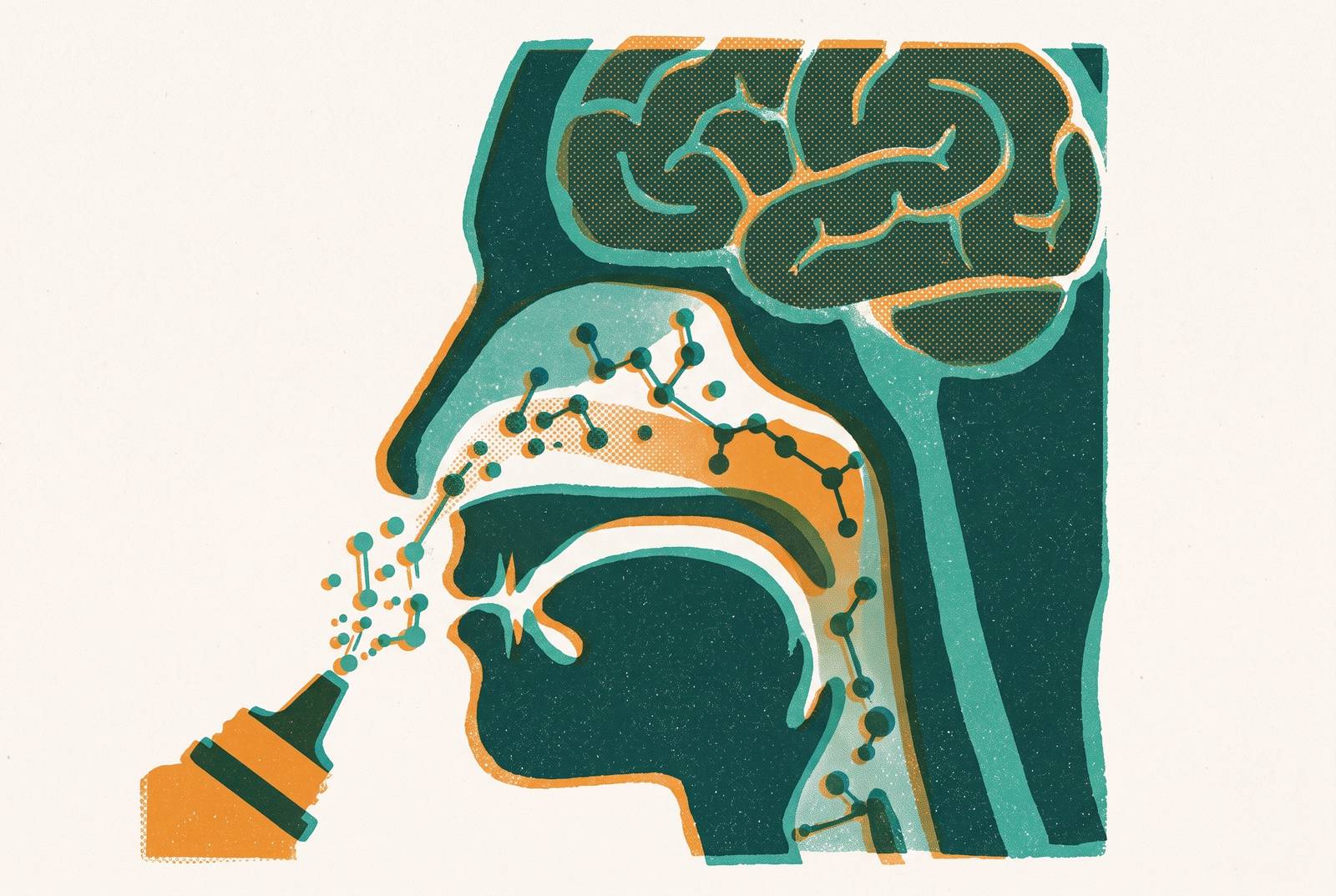
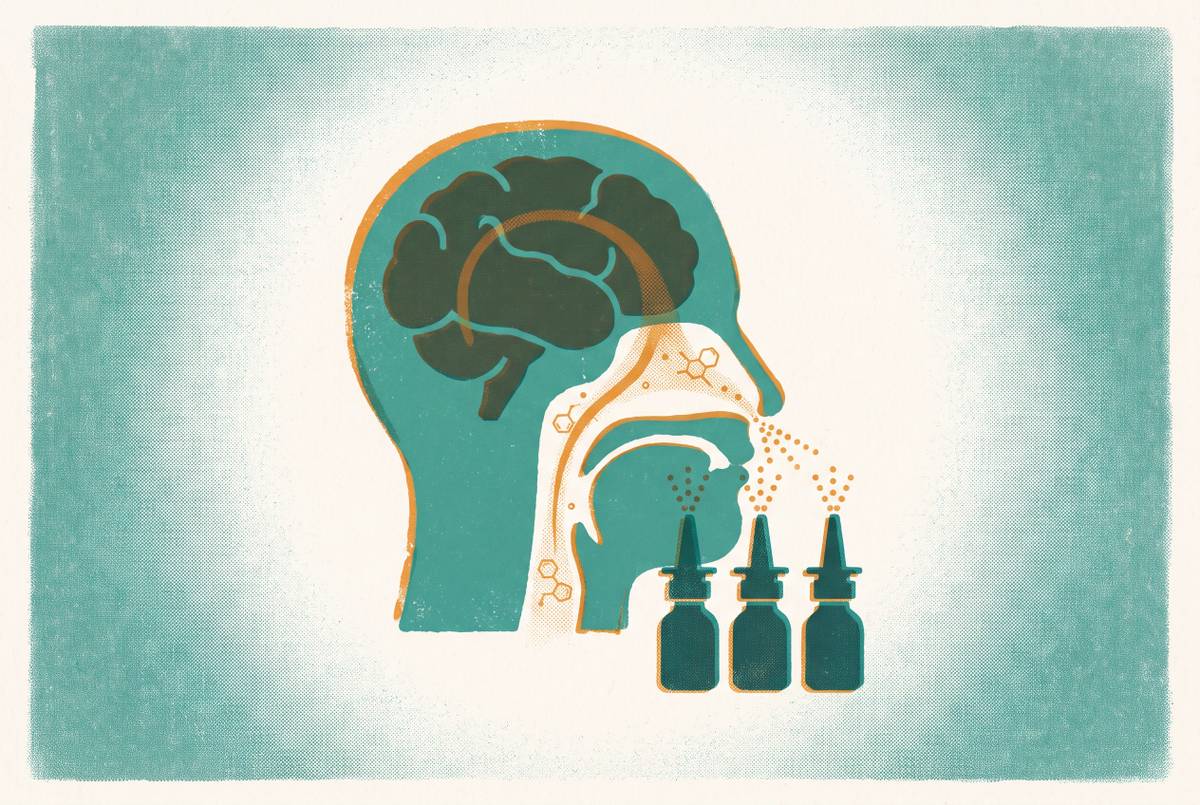
Nanoparticle nose-to-brain delivery for CNS peptide indications uses the olfactory and trigeminal pathways to bypass the blood-brain barrier. Nanocarriers protect peptides, extend nasal residence time, and help them cross the nasal epithelium. This structurally distinct route has promising preclinical evidence, but its clinical credibility depends on reproducible human delivery.
Why the blood-brain barrier blocks most drugs that need to reach the brain
The blood-brain barrier is an active exclusion system. Its non-fenestrated capillary endothelial cells are sealed by tight junctions, restricting passage between cells. A molecule therefore has no open gap through which to slip from the bloodstream into brain tissue. Even when it gains partial entry, P-glycoprotein and other energy-dependent transporters can pump it back out. Passive restriction and active efflux work together.
What remains available through transcellular diffusion favors sufficiently small, highly lipophilic molecules, a description most peptides and biologics do not fit. Their difficulty crossing the barrier is structural. More systemic exposure can cause more peripheral effects without the same rise in brain exposure. A drug taken by mouth also faces hepatic first-pass metabolism, and systemic elimination leaves less of it available after either oral or parenteral dosing. A drug approaching the brain through the bloodstream therefore reaches the barrier only after an already costly, lossy journey.
How the nose connects directly to the brain without crossing the bloodstream
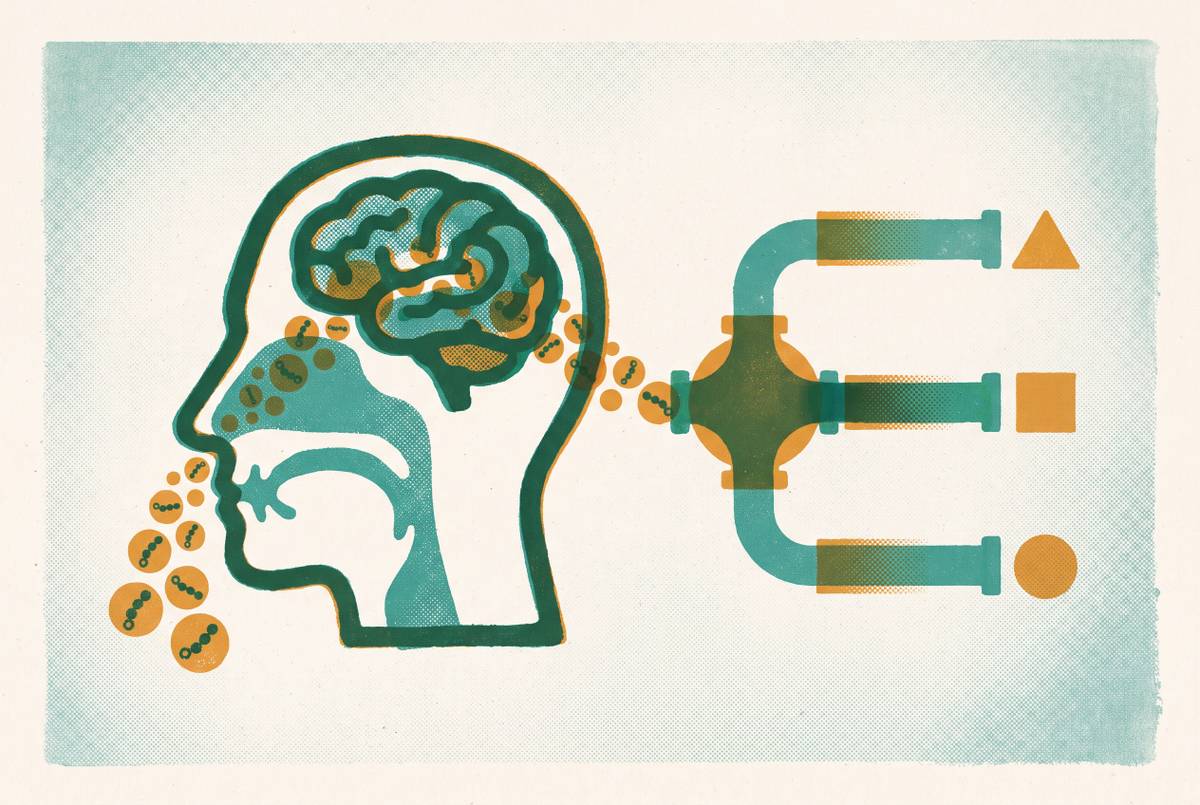
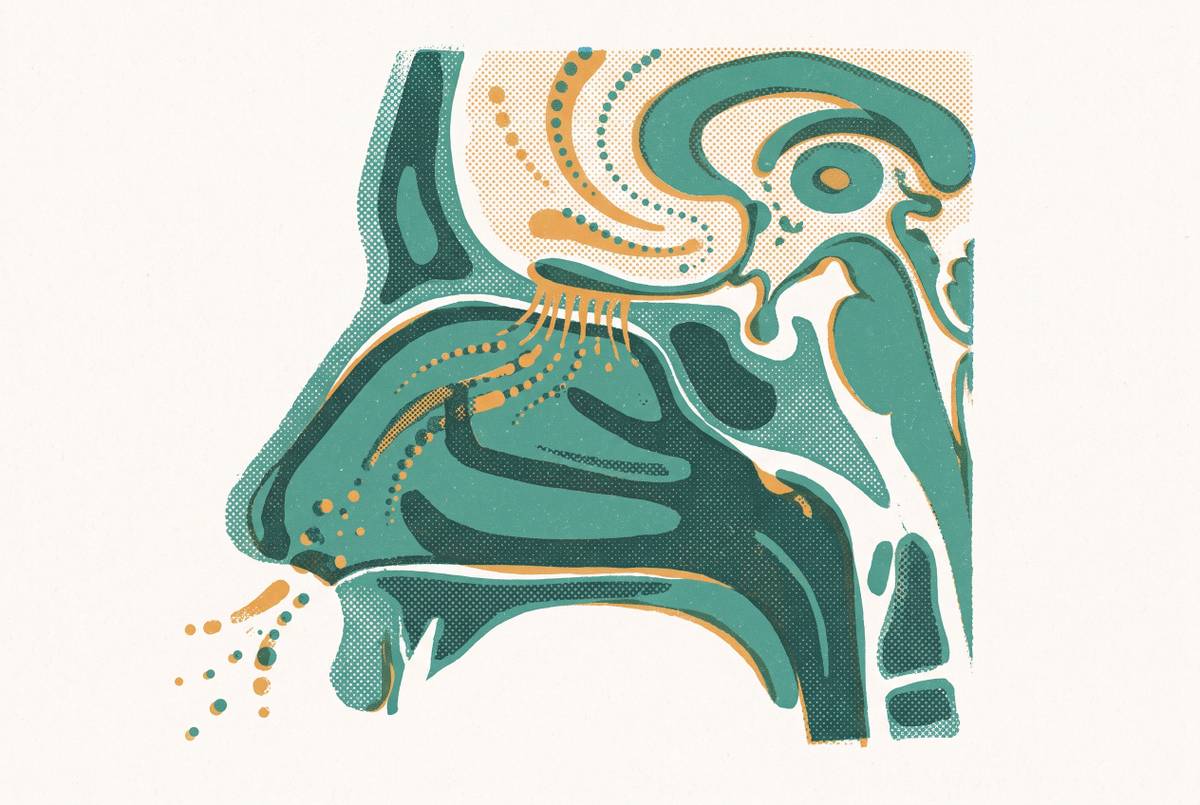
The nasal cavity offers a different anatomical interface. At its roof, the olfactory epithelium contains receptor neurons whose axons pass through the cribriform plate into the olfactory bulb. A molecule deposited here can cross the epithelium through gaps along sustentacular cells, which support those neurons, and pass the basement membrane. From there, access to spaces around the nerves provides a route toward the subarachnoid space and cerebrospinal fluid. This route can carry a molecule without taking it through systemic circulation.
That geography distinguishes nasal targeting from another injection site. The larger respiratory region mainly conditions and protects the airway, while the olfactory region has the direct interface of most interest for getting drugs to the brain. Yet the respiratory surface is not irrelevant. Trigeminal nerve branches innervate both regions and offer a second corridor toward the brainstem and deeper CNS structures. Together, the two pathways extend the possible reach beyond the olfactory bulb while avoiding hepatic first-pass metabolism on the direct journey.
What transport mechanisms actually move a molecule from the nasal epithelium into brain tissue
An anatomical connection does not explain how a payload travels. Does the molecule go into a neuron, pass between cells, or cross a supporting cell? All three mechanisms are relevant. In the intraneuronal route, endocytosis admits molecules into olfactory receptor neurons, after which axonal transport moves them along the olfactory nerve. This transcellular mechanism is particularly relevant to larger molecules such as peptides.
Paracellular transport instead moves molecules between sustentacular cells into the lamina propria and then into the perineural space around olfactory nerve bundles. This route is faster and less selective, and smaller, more water-soluble molecules pass through it more easily. Transcytosis through sustentacular and Bowman's gland cells offers another pathway for molecules able to engage receptor-mediated endocytosis. Once outside the cells, movement through perineural or perivascular spaces and toward cerebrospinal fluid can support wider distribution without entry into a blood vessel. The trigeminal pathway complements this access by reaching the brainstem, cerebellum, and spinal cord.
These mechanisms are not yet fully characterized. Finding a drug in brain tissue does not, on its own, show which pathway brought it there or which mechanism did most of the work. A delivery vehicle must work with several possible transport processes because the anatomy still does not fully explain how the payload travels.
Why large peptides are the molecules most in need of this route — and most structurally challenged to use it
Peptides bring the central contradiction into sharp focus. Their size, hydrophilicity, and susceptibility to enzymatic degradation make systemic brain delivery difficult, but those same properties also impede passage through the nasal epithelium. GLP-1 receptor agonists face this tension because central receptors are important targets for treatment, but peripheral administration reaches them by an indirect route. As peripheral exposure rises, it can cause dose-dependent nausea, vomiting, and diarrhea. The way the drug is delivered thus helps determine how well people can tolerate it.
A 2026 JAMA Network Open study of U.S. adults on GLP-1 medications found that fewer than one in four remained persistent at 12 months, with gastrointestinal side effects the primary driver of discontinuation. That is the human consequence of inefficient delivery. It explains the incentive to separate central exposure from peripheral dose. Without formulation aids, however, intranasal bioavailability of most proteins and peptides is typically well below a few percent in preclinical models. Enzymes in nasal mucus degrade the payload, while mucociliary clearance moves deposited material toward the nasopharynx and away from the olfactory surface. Moving the dose to the nose relocates the bottleneck unless the formulation addresses these structural constraints.
How do nanoparticles deliver large-molecule peptides to the brain through the nasal route?
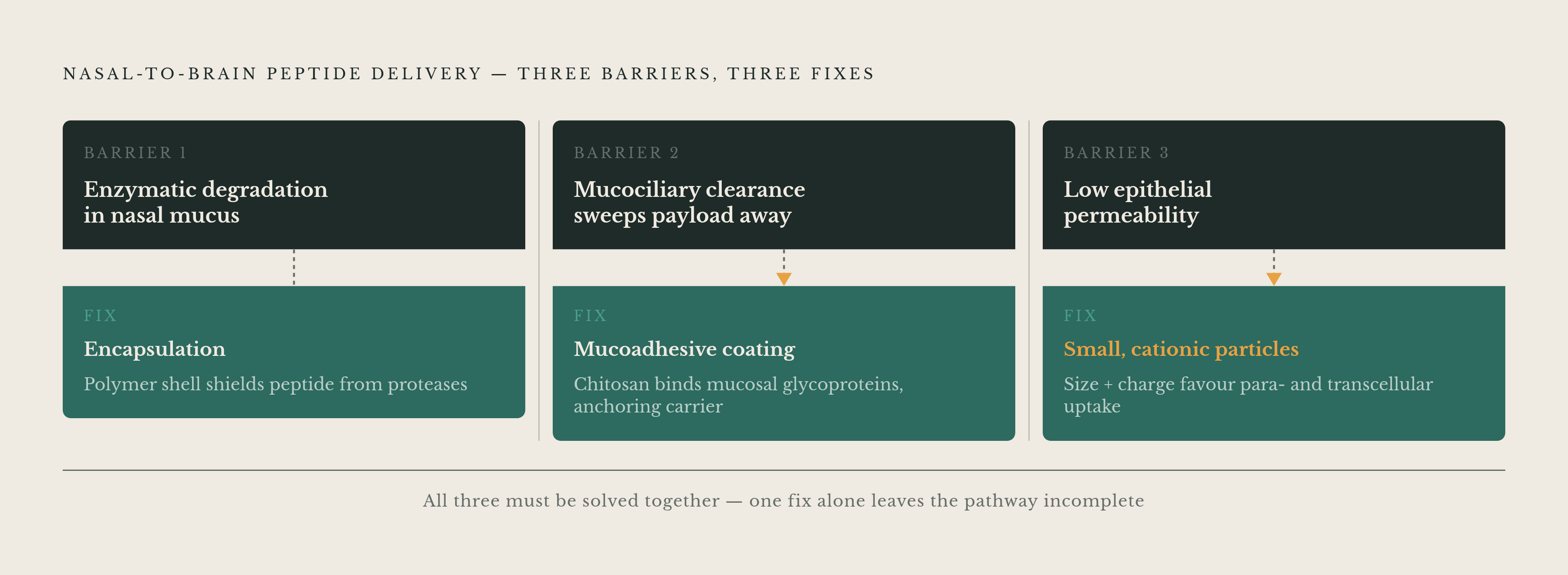
Nanocarriers address three linked failures of unaided nasal delivery, namely degradation, clearance, and low epithelial permeability. Encapsulation shields a peptide from enzymes in nasal mucus before it reaches the epithelium. Protection comes first, but it is not sufficient. Even a protected payload has little time to be absorbed if it leaves the target surface too quickly. Mucoadhesive surface chemistry, including chitosan coatings, binds to mucosal glycoproteins and extends residence time against the action of mucociliary clearance.
Smaller, positively charged particles favor paracellular and transcellular uptake, while larger particles may depend more on endocytic pathways at the epithelial surface. Engineering must therefore ensure that a nanoparticle accommodates and protects the peptide, remains at the useful surface, and engages a viable transport mechanism.
Lipid-based systems, ionic-liquid platforms, and extracellular vesicles represent different parts of this development landscape. For any platform, the relevant design decisions are the particle architecture, surface chemistry, and interaction with the nasal interface. Nanocarriers become an enabling layer when these choices work together, rather than when a formulation merely contains nanoscale material.
What the pharmacokinetic evidence shows — preferential brain targeting over systemic exposure
MetP Pharma's 2025 rat study reported brain-to-plasma ratios consistently greater than 1 after intranasal semaglutide. Brain exposure increased proportionally with dose and appeared rapidly after administration. This is the central preclinical signal of preferential brain targeting. Rather than relying on the fraction of circulating drug that crosses the BBB, the formulation produced a distribution profile weighted toward the brain.
Nasal formulations can achieve lower overall systemic exposure than injectable alternatives, creating the possibility of reducing dose-dependent peripheral effects. Yet a favorable distribution ratio is not a clinical tolerability result. Nor does finding the drug quickly in the CNS prove which of the available transport mechanisms brought it there. Pharmacokinetics establishes where exposure occurred and how it changed.
Rodents and humans differ in the relative extent of olfactory and respiratory epithelium, so an effective nasal deposition pattern in one does not establish equivalent delivery in the other. Nose-to-brain transport has been demonstrated in animals and humans, but human translational data remain sparse. The rat result supports this way of delivering the drug but leaves open the human dose, regional distribution, and therapeutic benefit.
Where the route has already been validated in approved clinical products
Nayzilam (midazolam nasal spray) is approved by the national drug regulator for acute treatment of seizure clusters. These products establish a regulatory precedent for intranasal treatment of CNS conditions. The seizure treatments also show the value of treating people quickly without IV administration.
Approved intranasal treatment is not equivalent to proof that direct olfactory or trigeminal transport accounts for its therapeutic effect. Nor does small-molecule approval establish that a nanoparticle peptide formulation will behave similarly. All three approved products are small molecules, and intranasal insulin is still in pilot trials and has yet to be approved for use. The field is thus moving from nasal treatments already in use to the harder task of reliably delivering large peptides in humans.
Why GLP-1 receptor agonists are the most consequential test case for intranasal peptide delivery
Receptors in the hypothalamus and brainstem govern appetite and satiety signaling, while those in the ventral tegmental area and nucleus accumbens are implicated in the emerging addiction signal. These targets make regional exposure important. Reaching the CNS is only the first question, because reaching a particular circuit may be more relevant than increasing total brain concentration. Preclinical intranasal exenatide and dulaglutide also show rapid preferential accumulation in the hippocampus and neocortex, connecting the route to cognitive applications.
Some Phase II trials of exenatide and lixisenatide in Parkinson's disease showed motor benefit, but Phase 2 NLY01 and Phase 3 exenatide trials did not. A 2026 meta-analysis of randomized controlled trials across Alzheimer's and Parkinson's disease found a small, statistically significant improvement in global cognition that was not clinically meaningful and was not replicated in Alzheimer's-only analyses. A May 2026 Lancet randomized controlled trial involving 108 participants found a significantly greater reduction in heavy-drinking days than placebo. These findings provide signals for the therapeutic class, with proof of an intranasal delivery platform still outstanding.
Kariya Pharmaceuticals has completed Phase I clinical trials for DA5-CH (KP405), a CNS-penetrant dual GLP-1/GIP analogue, for Parkinson's disease. Baseline Therapeutics plans to start two Phase 3 trials of a GLP-1 compound for alcohol-use disorder in early 2027. Neither milestone establishes how to reach particular brain regions. The same 2026 meta-analysis found poorer verbal fluency associated with GLP-1 receptor agonists, supported by high-certainty evidence. That counter-signal strengthens the case for investigating controlled regional exposure.
What the real barriers to clinical translation look like — and what separates credible programs from vaporware
Dosing reproducibility begins with a variable biological surface. Nasal anatomy, administration technique, congestion, and formulation viscosity can change deposition both between patients and within the same patient. A formulation may therefore give consistent exposure in a controlled experiment but uneven exposure when people use it. Differences in GLP-1 receptor expression add another source of variability. The absence of real-time imaging tools for personalized dosing leaves that uncertainty difficult to resolve at the individual level.
Manufacturing introduces a separate test of the platform. Particle size distribution, surface chemistry, and encapsulation efficiency can change as more is made, so a formulation that works at the bench may lose its pharmacokinetic properties at manufacturing scale. Regulatory development requires promising exposure data, batch-to-batch reproducibility, and a defensible mechanistic rationale. Few preclinical candidates in novel peptide delivery have successfully completed Phase 2 trials. That record makes human translation a substantive development stage after a positive rodent study.
The broader field is also accelerating beyond nasal delivery. A May 2026 program funded by a government biomedical research agency disclosed that the oral small-molecule GLP-1 receptor agonists orforglipron and danuglipron penetrate deep into the brain, reaching the central amygdala in mice. With more than one route to CNS GLP-1 exposure, every platform that claims an advantage faces greater urgency to provide stronger evidence to back it up.
Particle architecture, surface ligand selection, and mucoadhesive chemistry must produce reproducible formulations. Deep nanoparticle intellectual property is valuable when it embodies those durable design capabilities and supports breadth beyond a single formulation.
Sources
- Nanotherapeutics for Nose-to-Brain Drug Delivery: An Approach to Bypass the Blood Brain Barrier
- The Nasal–Brain Drug Delivery Route: Mechanisms and Applications to Central Nervous System Diseases
- Nanotherapeutics for Nose-to-Brain Drug Delivery: An Approach to Bypass the Blood Brain Barrier
- Nose-to-brain drug delivery: from bench to bedside
- Advancements in Nanocarrier Systems for Nose-to-Brain Drug Delivery
- Intranasal Nano-Delivery Systems: Emerging Strategies for Central Nervous System Disease Therapeutics - PMC
- Intranasal delivery of glucagon-like peptide-1 to the brain for obesity treatment: opportunities and challenges: Expert Opinion on Drug Delivery: Vol 21 , No 7 - Get Access
- Nose-to-brain drug delivery: from bench to bedside