Companies Developing Intranasal Biologics and Peptide Therapeutics
Delivery platforms define this field, yet none has proven clinical benefit.

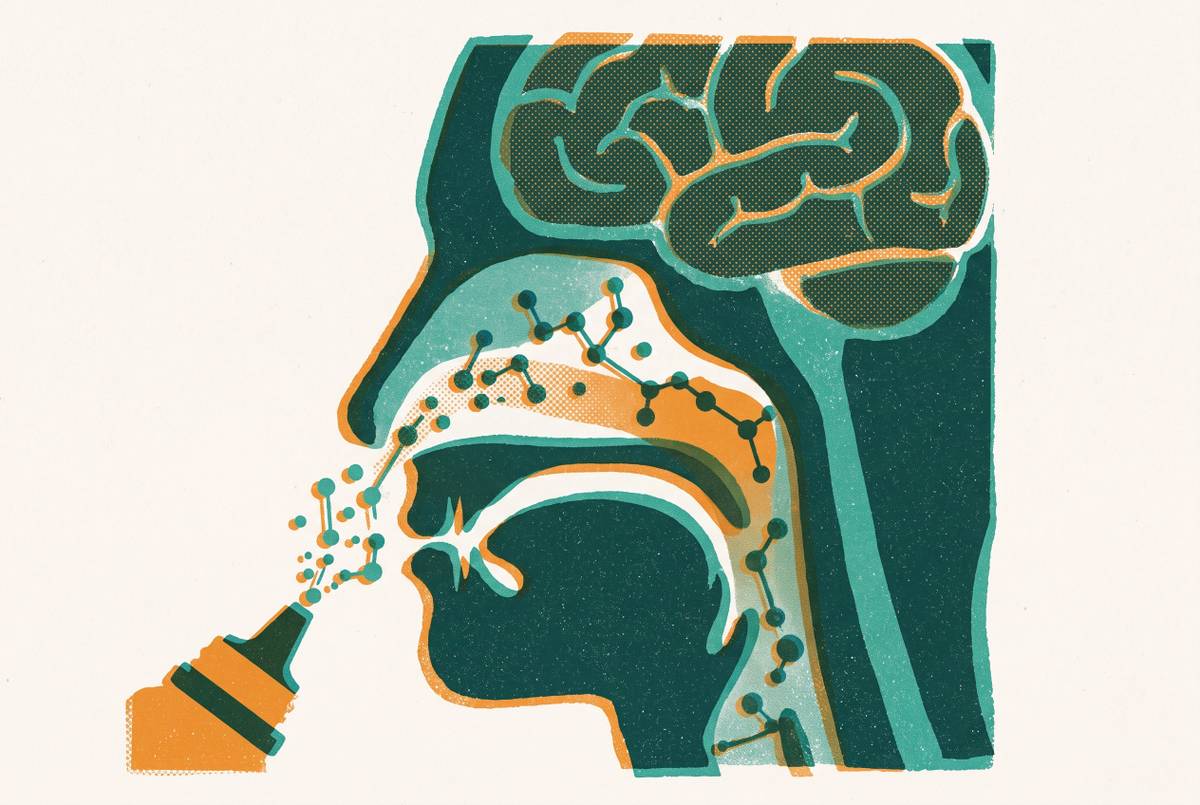
Nanoparticle nose-to-brain delivery for CNS peptide indications uses protective carriers to help fragile peptides pass through nasal mucus and epithelium toward olfactory and trigeminal pathways that bypass the blood-brain barrier. Companies developing intranasal biologics and peptide therapeutics are best understood through their delivery platforms, including nanoparticles, cell-penetrating peptides, and aerosol engineering. These technologies define the competitive frontier, but none yet establishes a broadly validated route from nasal peptide dosing to clinical benefit.
How does nasal delivery get peptides to the brain?
Olfactory neurons provide an unusual physical connection between the nasal cavity and the brain. Their cell bodies sit in the nasal mucosa, while their axons project through the cribriform plate into the olfactory bulb. Molecules can travel through intracellular axonal routes or faster extracellular routes in the perineural space. This anatomy offers access that does not require a peptide to cross the blood-brain barrier from circulating blood.
The trigeminal pathway extends that opportunity beyond the olfactory bulb. Its branches innervate the respiratory epithelium and provide routes toward the brainstem and pons, giving nasal delivery more than one potential point of entry. A third route takes the drug into nasal blood vessels and then into systemic circulation. But that route is less able to target the brain alone. Whether a drug is absorbed through the nose therefore matters alongside which pathway it enters and where it ultimately reaches.
Why bare molecules fail at the nasal mucosa and what that means for developers
A physical connection to the brain is not an unobstructed passage. Before an unprotected peptide can reach neural pathways, it encounters mucus, endogenous enzymes, and epithelial cell membranes. Its high molecular weight and structural complexity contribute to extremely low transmembrane permeability, while enzymes can degrade it before useful absorption occurs. These are distinct, sequential barriers. A formulation that protects a peptide from degradation may still leave it unable to penetrate mucus or enter cells.
Mucus itself acts as both a physical mesh and a biochemical filter. Once a peptide passes through it, the epithelium presents another obstacle, requiring transport across or uptake into epithelial and neural cells. At the same time, mucociliary clearance leaves less time for either step. An unmodified liquid formulation may disappear before meaningful absorption. A longer residence time gives the peptide more time to be absorbed, while better permeability helps it cross the barriers, even when one carrier is designed to do both.
For developers, this changes the basis of comparison. Two programs using an interesting target molecule may have very different chances of success if their formulations differ in how they protect it, transport it, and deposit it at the olfactory epithelium. What enables this payload to survive the nasal environment and reach its intended route? Delivery platform choice is consequently a strategic distinction, rather than a formulation detail added after molecule selection.
The three main delivery technology families competing to solve this problem
Nanoparticle carriers make their primary bet on protection and surface engineering. Polymeric, lipid, and hybrid systems encapsulate peptides to shield them from enzymatic degradation, while their surfaces can be tuned to interact with mucus, promote neuronal uptake, and extend nasal residence. One design choice can serve several functions. Yet a protective carrier still needs evidence that its payload moves beyond the nasal compartment and reaches relevant brain cells.
A 2026 study published in Biomaterials described NanoInBrain, a modular hybrid biomaterial platform that connects those design goals to preclinical measurements. Ex vivo Franz diffusion studies and a nasal-mucosa-on-chip model demonstrated robust permeation, while in vivo imaging showed brain distribution and intracellular uptake in neurons and microglia. Incorporating the HA-CP component prolonged nasal residence to approximately four hours and increased total brain exposure. These are complementary measurements of different delivery steps. They support the platform’s engineering rationale without establishing clinical effectiveness.
Cell-penetrating peptides, or CPPs, place greater emphasis on membrane transport. These short protein transduction domains, typically 5–30 amino acids long, facilitate intracellular transport of conjugated or co-administered cargo. Their applications include intranasal insulin and exendin-4 delivery to systemic and brain compartments. CPPs can function as standalone carriers or nanoparticle surface coatings, coupling membrane penetration with the protective functions of a nanocarrier.
Aerosol engineering addresses a different question about where the formulation lands. Liquid sprays, dry powder inhalers, and nebulizers deposit material in different nasal regions, with device geometry and droplet characteristics influencing access to the upper nasal cavity. Targeting the olfactory epithelium therefore requires more than a suitable molecule-carrier combination. Placement is part of the delivery mechanism itself. The distinct uncertainties are whether the carrier protects and transports its cargo, whether membrane entry is effective, and whether the device deposits a reproducible dose at the intended site.
What the clinical track record actually shows about which approaches work
Intranasal oxytocin offers the field’s most extensive clinical test of a nose-to-brain peptide. It has been studied in over 100 clinical trials involving autism, social behavior, and psychiatric conditions. Early smaller studies reported altered amygdala activity, improved trust, and enhanced social responsiveness. Larger trials have complicated that promising picture. Sikich et al.’s 2021 NEJM trial found that intranasal oxytocin did not improve social behavior in children with autism.
That result does not identify a winning delivery platform, or establish delivery as the reason for the negative outcome. It shows why an early biological signal cannot take the place of a rigorous clinical endpoint. In animal models, it reached amygdala targets within hours of nasal administration and showed promise for PTSD prevention. Whether those findings will lead to a treatment that works in humans is still unknown.
A completed trial tested intranasal sumatriptan given through a device designed for that use. It showed that the drug worked faster than oral dosing, with migraine pain intensity falling significantly within minutes after the dose. This supports the clinical importance of device-and-formulation design, rather than establishing nanoparticle delivery of CNS peptides. The distinction limits what can reasonably be inferred. As of 2026, no nose-to-brain peptide formulation has received FDA approval, and the available evidence does not support declaring any platform family the winner.
How companies are placing bets across these delivery platforms today
Aptar Pharma provides a direct example of a delivery specialist entering the GLP-1 opportunity. In May 2026, the global drug delivery company announced publication of three new international patent applications focused on enabling inhaled and nasal delivery of these biologic therapies. The activity expands its biologics capabilities into intranasal and pulmonary GLP-1 delivery. The company starts with how to deliver a molecule before looking for new ones. Patent activity alone, though, does not show how well a treatment works in patients or whether it targets the brain directly.
ILiAD Biotechnologies, based in Weston, FL, illustrates a different development path. It raised a large Series B to support Phase 3 development of its intranasal pertussis vaccine candidate BPZE1, with a pivotal human challenge study planned for 2026. Leyden Labs, based in the Netherlands, raised funding for intranasal antibody programs intended to protect against respiratory viruses, including influenza and coronaviruses. These programs broaden the intranasal biologics landscape. They demonstrate investment in nasal administration of complex biological products, but they are not evidence that a CNS peptide has been delivered through a nanoparticle platform.
Syneron Bio and Orbis Medicines extend the picture into peptide-platform financing. Syneron secured substantial funding across Series A and extension rounds, with investors including AstraZeneca and the Pfizer Biotech Development Investment Fund, while Orbis raised a comparable Series A. Their inclusion reflects peptide-platform differentiation, with no documented shared intranasal mechanism. The distinction prevents a misleading company map. Across these examples, funding, partnerships, and patents show interest in platform capabilities, but they do not establish that every organization is developing nanoparticles for direct peptide delivery to the brain.
Why GLP-1 peptides have become the highest-stakes test case for intranasal delivery
GLP-1 receptor agonists bring the delivery question into sharp clinical and commercial focus because treatment persistence is already a major constraint. About half of users report nausea, and roughly a third report diarrhea, with gastrointestinal side effects the most common reason for discontinuation. A JAMA Network Open cohort study of more than one hundred thousand patients found that nearly two-thirds of patients without type 2 diabetes discontinued within one year. Long-term persistence is substantially worse. Patients who stop early lose substantially less weight than clinical trial benchmarks, showing how adherence affects efficacy.
Patients on Medicaid or Medicare, Black patients, and those experiencing gastrointestinal side effects were more likely to discontinue. A less burdensome delivery route therefore raises questions beyond convenience. Could it change who remains on treatment long enough to benefit? Nasal dosing alone does not answer that question, and any claim that it improves persistence or reduces side effects would require clinical evidence.
The neurological rationale is distinct from the case for avoiding injections. GLP-1 is produced in the nucleus tractus solitarius of the brainstem and acts as a neurotransmitter in multiple brain regions involved in reward processing. Its receptors are expressed in the hippocampus, frontal cortex, and substantia nigra. Receptor agonists activate signaling cascades that promote neuronal survival, enhance synaptic plasticity, reduce oxidative stress, and modulate neuroinflammation. This is more than a peripheral metabolic hypothesis. Because GLP-1 plays a part in the mesolimbic reward system, delivering it more directly to the brain might also help address addiction-related behaviors.
But this plausible mechanism has not led to consistent neurological benefit. A 2025 study found that GLP-1s did not slow the disease in patients who already had Alzheimer’s disease. That finding leaves delivery’s role in the outcome unresolved. Cell permeation enhancers, mucoadhesive systems, nanocarriers, and efficient devices have shown promising preclinical results for nasal GLP-1 delivery. The demanding test is whether a different exposure pattern produces a benefit that systemic administration has not reliably achieved, rather than merely reproducing an attractive mechanism in another formulation.
What it takes to actually translate a delivery platform from preclinical results to a viable therapy
Dose quantification and reproducible delivery to the olfactory epithelium remain central regulatory obstacles. The same aerosol parameters that determine deposition also influence dose reproducibility, so device design cannot be separated from formulation design. A carrier’s performance depends on how it is administered. For that reason, platform development needs to address the device-formulation combination from the start, rather than treating the device as packaging for an otherwise finished therapy.
Mucosal biology makes that integration especially demanding. Mucociliary clearance rate, nasal pH, enzymatic activity, and differences in anatomy between individuals affect how much formulation reaches the intended site. Those variables also limit straightforward extrapolation from preclinical results. NanoInBrain’s mucosa-on-chip approach addresses part of this uncertainty by testing permeation in a model of the nasal barrier. Such models offer a way to examine delivery under biologically relevant conditions, but they do not replace evidence of reproducible human exposure and benefit.
The Vivtex / MIT Langer Lab spin-out example illustrates the value and partnership potential of foundational delivery IP built through years of academic research. Decades of nanoparticle IP, validated mucosal biology models, and device-formulation co-design provide a deeper foundation than an isolated claim around a novel molecule. None guarantees that a therapy will succeed. They address different parts of the path from its first experimental step toward regulatory submission.
Patient experience belongs within that engineering work. The GLP-1 adherence evidence shows how treatment burden and gastrointestinal side effects can undermine the benefits suggested by trial benchmarks. Platforms targeting the olfactory epithelium may reduce systemic exposure and peripheral gastrointestinal effects, but that remains a proposition to test. The field is still early enough that clinical timelines and regulatory outcomes cannot be assumed. The companies that shape this field will have delivery platforms that bring together deep IP, knowledge of the mucosa, and devices and formulations designed to work together well enough to turn a nasal biologic into an approved therapy.
Sources
- Brain delivery strategies for biomacromolecular drugs: intranasal admi
- Systemic and brain delivery of antidiabetic peptides through nasal administration using cell-penetrating peptides
- Nose-to-Brain Delivery of Therapeutic Peptides as Nasal Aerosols
- The Nasal–Brain Drug Delivery Route: Mechanisms and Applications to Central Nervous System Diseases - PMC
- Intranasal Peptide Therapeutics: A Promising Avenue for Overcoming the Challenges of Traditional CNS Drug Development
- Cell-Penetrating Peptides as Valuable Tools for Nose-to-Brain Delivery of Biological Drugs
- A rationally designed polypeptide-based hybrid platform for targeted intranasal brain drug delivery - PubMed
- Liposomal Formulations for Nose-to-Brain Delivery: Recent Advances and Future Perspectives