Matching Nanoparticle Platform Architecture to Peptide Biologic Cargo for Intranasal CNS Delivery
Designing nanoparticles to deliver peptides across the blood-brain barrier through the nose.
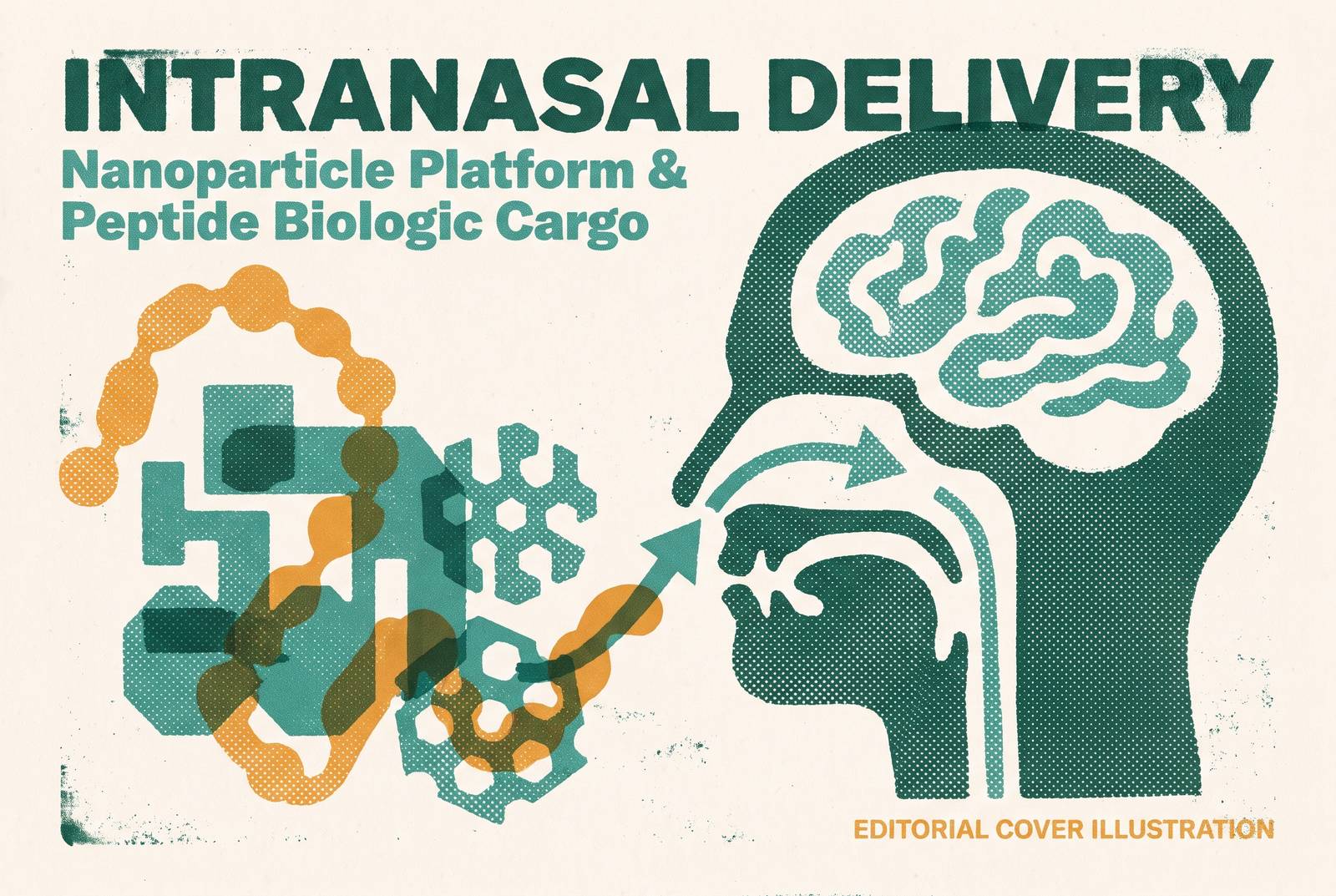
Nanoparticle nose-to-brain delivery for CNS peptide indications depends on matching the carrier to the cargo. Intranasal delivery can bypass the blood-brain barrier through olfactory and trigeminal pathways, but the peptide must survive transit and reach its target intact. The peptide’s survival in transit and intact arrival at its target depend jointly on particle size, surface chemistry, mucoadhesion, charge, and encapsulation geometry.
Why the blood-brain barrier forces a rethink of peptide delivery from the start
GLP-1 receptors occur throughout the hippocampus, neocortex, hypothalamus, and cerebellum, yet the blood-brain barrier restricts access to these sites. Its endothelial cells, tight junctions, astrocytes, and pericytes selectively admit essential nutrients while excluding many exogenous substances. The target and the treatment remain physically separated.
Endogenous GLP-1 has a half-life of only two minutes because of renal clearance and degradation by DPP-4. Injectable analogues extend circulating half-life, but persistence does not by itself solve CNS penetration, while systemic exposure engages peripheral GI receptors. Direct invasive delivery can provide CNS access, but its invasiveness limits its suitability for sustained treatment.
How the olfactory and trigeminal pathways offer a direct anatomical bypass
Intranasal delivery gives peptides a route that bypasses the blood-brain barrier. Olfactory nerves connect the olfactory epithelium with the brain, providing a pathway from the nasal cavity into the CNS. Trigeminal pathways provide a parallel route relevant to subcortical and spinal targets.
MetP Pharma’s January 2026 release reported that a 2025 rat study produced brain-to-plasma ratios consistently above 1 after intranasal semaglutide administration using its technology. That result supports preferential CNS exposure in that model. It gives the bypass argument a basis in measured results, though it does not show human target engagement or prove that there are no adverse effects. Whether the peptide can survive the nasal environment long enough to use this bypass remains unresolved.
Why bare peptide molecules cannot survive the nasal transit on their own
Proteases threaten peptide integrity, while mucus and the epithelium impede passage toward neural pathways. Mucociliary clearance further shortens the available absorption window. A formulation that protects its cargo but leaves the cavity before uptake has solved only part of the problem.
Deposition narrows that window spatially as well as temporally. Human olfactory epithelium occupies roughly three to five percent of nasal surface area, compared with roughly half in rodents. Most human nasal surface is therefore not the intended olfactory entry point. Protection against enzymes must work together with sufficient residence time and access to the relevant epithelium. Encapsulation addresses the vulnerability of bare peptides, but meeting these requirements simultaneously is the job of platform architecture.
The five architectural variables that determine whether a nanoparticle platform fits its peptide cargo
Particle size sets a balance between penetration and protection. A carrier must pass through the mucus gel while retaining enough structure to enclose its peptide payload. Smaller is not automatically better for this task. Very small particles can clear faster, and peptides with different molecular weights and conformations impose different requirements on the space needed for encapsulation.
Surface chemistry determines how that carrier interacts with the route. Targeting ligands such as transferrin and lactoferrin, together with coatings including polysorbate 80 and PEG, provide ways to alter transport and stability. Ligand choice can also change anatomical routing. PLGA nanoparticles functionalized with rabies virus glycoprotein peptide, RVG29, achieved multi-fold higher trigeminal payload delivery than control nanoparticles two hours after intranasal administration. This makes surface engineering relevant not just to total brain accumulation, but to where the payload travels.
Mucoadhesion buys time, but time must enable uptake. Natural polymers including chitosan, alginate, and gelatin can prolong nasal residence while supporting stability and controlled release. Conejos-Sánchez et al.’s NanoInBrain platform combined a polypeptide-based nanocarrier with a hyaluronic acid-poly-L-glutamate crosspolymer depot-forming hydrogel, HA-CP, Yalic®. Its May 2026 study reported approximately four hours of nasal residence and increased total brain accumulation. Yet polymer selection remains cargo-dependent because electrostatic interactions with the peptide can change release kinetics.
Positively charged carriers interact with negatively charged mucus, which can prolong retention, but excess cationic charge can cause cytotoxicity. More adhesion is therefore not an unrestricted gain. The peptide’s own charge state at physiological pH also constrains the carrier’s charge without destabilizing the encapsulation complex.
Encapsulation geometry determines how protection gives way to release. Nanostructured lipid carriers can accommodate lipophilic and moderately hydrophilic drugs while protecting against enzymatic degradation. Synthetic polymer matrices such as PLGA and polycaprolactone offer tunable degradation rates, while hybrid systems combine functions that a single matrix may not provide. A carrier designed only around nasal transit may still release its peptide on a schedule poorly matched to receptor kinetics at the CNS target.
GLP-1 as the most demanding and highest-stakes test case for cargo-matched architecture
GLP-1 brings molecular fragility and treatment persistence into the same engineering problem. IQVIA’s 2025 analysis found substantial prescription abandonment before a first fill and discontinuation within two years among a majority of patients starting treatment for weight loss. Nausea is a major driver of dropout. The hypothesis that nauseating and food-intake-reducing effects are molecularly linked strengthens interest in changing exposure through delivery, although it does not establish that intranasal administration will eliminate nausea.
The cargo itself makes that route difficult to engineer. Its encapsulation must preserve the three-dimensional receptor-binding conformation, address enzymatic vulnerability, and support access to receptors distributed across different CNS structures. Can a carrier meet one need while failing to meet another? The 2026 PNPHO thermoresponsive nanocarrier study in International Journal of Pharmaceutics did exactly that, reporting prolonged nasal retention and improved glucose tolerance but no detectable brain fluorescence in vivo.
Why GLP-1’s neurological indications make CNS delivery the therapeutic priority, not a secondary benefit
Can GLP-1 receptor agonists reach the tissue where proposed neuroprotective mechanisms operate? A propensity-matched real-world cohort reported lower dementia incidence among GLP-1RA users, with a hazard ratio of 0.30. Mechanistically, GLP-1RAs can activate AMPK signaling in microglia, promote amyloid-beta phagocytosis, and suppress inflammatory cascades. These are brain-local processes, which makes local exposure central to the therapeutic hypothesis.
However, observational protection is not proof of treatment efficacy. The supplied clinical evidence reports no improvement in memory and cognition compared with placebo in patients with diagnosed Alzheimer’s disease, with low certainty. Insufficient CNS exposure is one proposed explanation for the disconnect. Intranasal architecture would need to demonstrate therapeutic exposure in hippocampal and cortical tissue rather than merely passage beyond the olfactory epithelium.
Other indications broaden the anatomical demands on that architecture. Parkinson’s disease involves subcortical and brainstem structures, giving trigeminal targeting a rationale beyond olfactory-only delivery. Addiction also calls for delivery to deep targets in mesolimbic reward circuits, and GLP-1RAs are being studied as a way to reduce smoking and alcohol misuse. Neither application establishes clinical benefit from a nasal platform. Together, they define a more demanding objective than total brain uptake, namely delivery to the particular CNS structures implicated in disease.
What companies and academic teams are developing intranasal nanoparticle platforms for CNS peptides?
MetP’s January 2026 report described rapid, dose-dependent brain targeting of semaglutide with low systemic exposure in preclinical work. Its contribution is limited to evidence of preclinical exposure. Landmark Medicines Ltd., based in Loughborough, UK, announced on September 29, 2026, plans to advance its proprietary nasal drug-delivery platform toward a human volunteer study. Landmark chose GLP-1 receptor agonists as the first treatment to pursue, and that work remains a plan with no completed clinical result.
Aptar Pharma’s May 2026 announcement addressed another part of translation. It reported patent filings and preclinical data supporting intranasal and pulmonary GLP-1 delivery through a biologics compatibility program. That program examines interactions between delivery systems and complex biologics, including peptides, proteins, nucleic acids, and associated nanoparticle systems. Device compatibility is a distinct engineering task. A formulation’s properties alone do not establish how it will perform when administered through a particular system.
NanoInBrain reported that its hybrid formulation was well-tolerated as a proof of concept, while the PNPHO study exposed a separation between mucosal performance and a detectable CNS signal. Neither finding supports ranking these platforms against the company programs. Their endpoints and development stages are different. Foundational encapsulation and surface chemistry intellectual property becomes relevant here as a basis for systematic redesign, rather than as evidence that any one formulation has completed translation.
The translational gap between current architectural successes and remaining failures
The strongest challenge to cargo-matched architecture is empirical. Even after the five variables are tuned, CNS delivery is not yet detectable in every system tested. The PNPHO result also raises an assessment question. What does a negative fluorescence result establish about intact peptide exposure? Prolonged retention or a metabolic response can establish successful CNS delivery only with direct evidence of the relevant drug concentration at the intended target.
The smaller olfactory region means rodent deposition and accumulation results cannot be assumed to transfer quantitatively to humans. Device-dependent variability can also send a well-designed carrier to non-olfactory mucosa. Deposition is therefore part of the delivery mechanism. Differences in mucosal thickness, mucus viscosity, and disease-state changes such as rhinitis introduce further variability that formulation design cannot fully remove.
Long-term safety data remain insufficient, while manufacturing scalability and regulatory alignment for complex nanocarriers remain field-level challenges. The absence of standardized characterization and assessment protocols complicates comparisons between programs. Neurological indications make the exposure standard more demanding still, because accumulation somewhere in the brain is not enough. Deposition precision, verification of CNS penetration, and human-scale anatomical performance define the next engineering frontier.
What cargo-first platform design requires going forward, and why foundational IP distinguishes programs equipped to close the gap
Future work needs to optimize mucoadhesion and mucopenetration together, refine ligand-based targeting, and validate performance in physiologically relevant models, including ex vivo human tissue. CNS penetration must be measured. Comprehensive chronic toxicity evaluation and regulatory alignment belong within platform development. Artificial intelligence-driven formulation design is a new tool for exploring how these variables affect one another, and its results still need biological validation.
A change in surface chemistry can alter retention, while a change in polymer or charge can affect peptide stability and release. IP that covers a broad range of encapsulation and surface chemistry can better support work across that design space than a patent for a single formulation. The practical value of patent breadth lies in the tested design principles and sustained research that allow a platform to adapt when one solution creates another constraint.
Architecture developed around GLP-1’s demands can inform work on other CNS-directed peptide biologics, including neuropeptides for addiction circuits and neurotrophic factors for neurodegeneration. Success with GLP-1 would validate a design approach, with efficacy still to be established for each subsequent indication. The broader objective is nanoparticle infrastructure that can be retuned around the molecule, the route, and the target together.
Sources
- Targeting the brain through the nose: Advances in polymeric nanoparticle delivery for schizophrenia - PubMed
- Advanced intranasal peptide delivery systems for improved management of Alzheimer's disease - PubMed
- A rationally designed polypeptide-based hybrid platform for targeted intranasal brain drug delivery - PubMed
- Intranasal Nano-Delivery Systems: Emerging Strategies for Central Nervous System Disease Therapeutics - PMC
- Navigating the Nose-to-Brain Route: A Systematic Review on Lipid-Based Nanocarriers for Central Nervous System Disorders
- Lipid and Polymeric Nanoparticles: Successful Strategies for Nose-to-Brain Drug Delivery in the Treatment of Depression and Anxiety Disorders
- Advancements in Nanocarrier Systems for Nose-to-Brain Drug Delivery
- Glucagon‐like peptide‐1 receptor agonists for neurological disorders: a systematic review and meta‐analysis