Nose-to-Brain Versus IV and Intrathecal Routes Scored Against the Clinical and Regulatory Realities of Peptide CNS Development
A route-by-route comparison shows nasal delivery's promise hinges on human data.
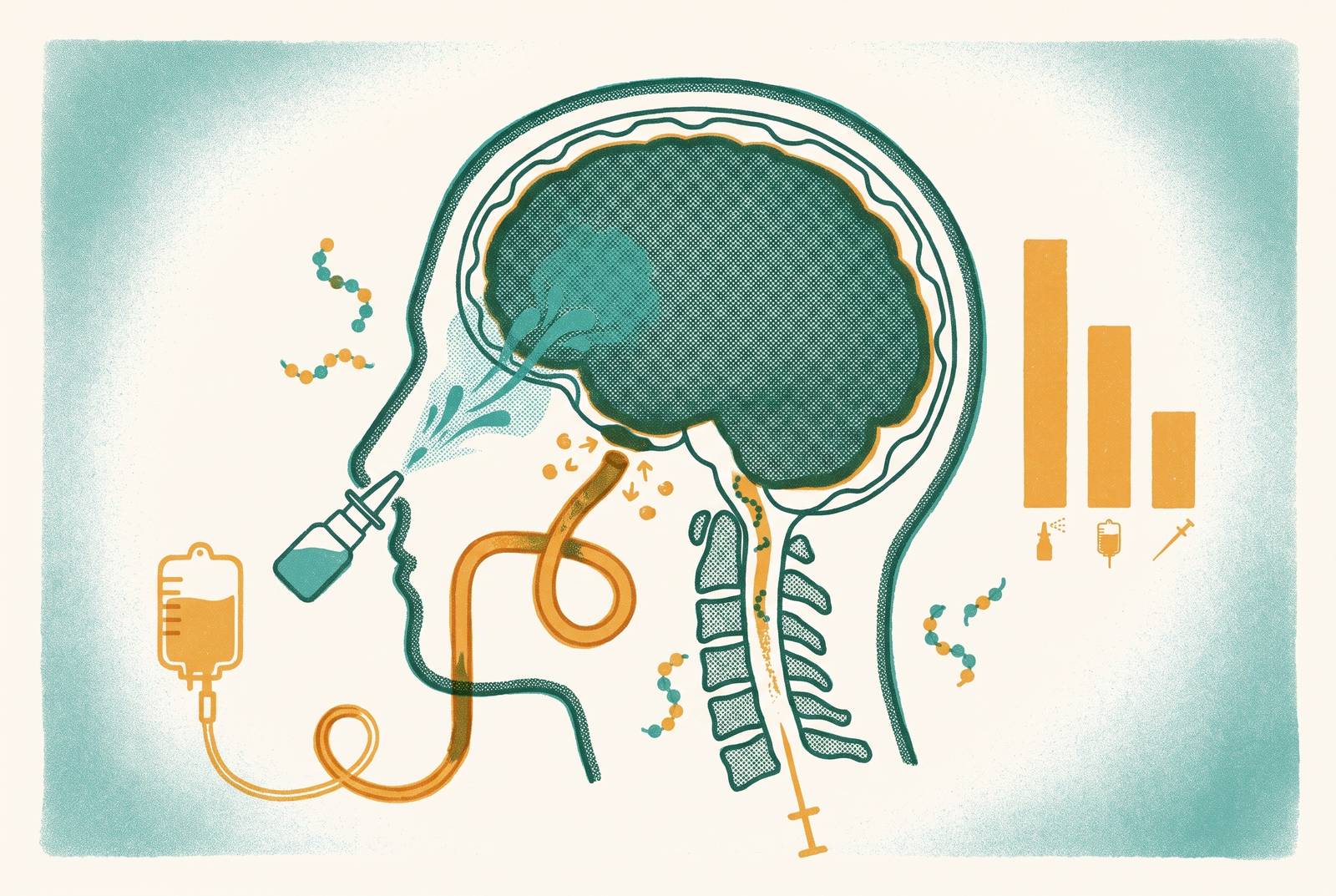
Nanoparticle nose-to-brain delivery for CNS peptide indications aims to bypass the blood-brain barrier through olfactory and trigeminal pathways while protecting peptides during nasal delivery. Compared with IV and intrathecal delivery, it could target the brain without the need to redesign the molecule or use invasive procedures. No route dominates, however, and the nasal route’s advantages still depend on reproducible human delivery and a credible regulatory case.
Why getting peptides into the brain is structurally different from every other drug delivery problem
Because of the blood-brain barrier, systemic exposure tells little about brain exposure. More than 98% of all potential CNS drugs do not cross it, and peptides face additional losses through enzymatic degradation and rapid renal clearance. Their size and hydrophilicity also work against passive diffusion across the barrier. For most unmodified candidates, peripheral dosing produces negligible brain exposure.
This changes the starting point of development. A peptide CNS program needs a deliberate way to cross or bypass the barrier. Can it reach concentrations high enough to treat the intended disease through a route whose dosing burden and risks are acceptable?
How do nasal, IV, and intrathecal routes get peptides into the brain?
IV delivery puts the drug into circulation but leaves the blood-brain barrier in place. Engineered transcytosis or receptor-mediated transport can provide passage across the endothelium, but unmodified peptides generally lack that access. Intrathecal delivery takes a different path entirely. It deposits drug directly into cerebrospinal fluid through lumbar puncture or an implanted pump, bypassing the barrier. Distribution then depends on movement through CSF, with uneven CNS exposure and some leakage into peripheral circulation.
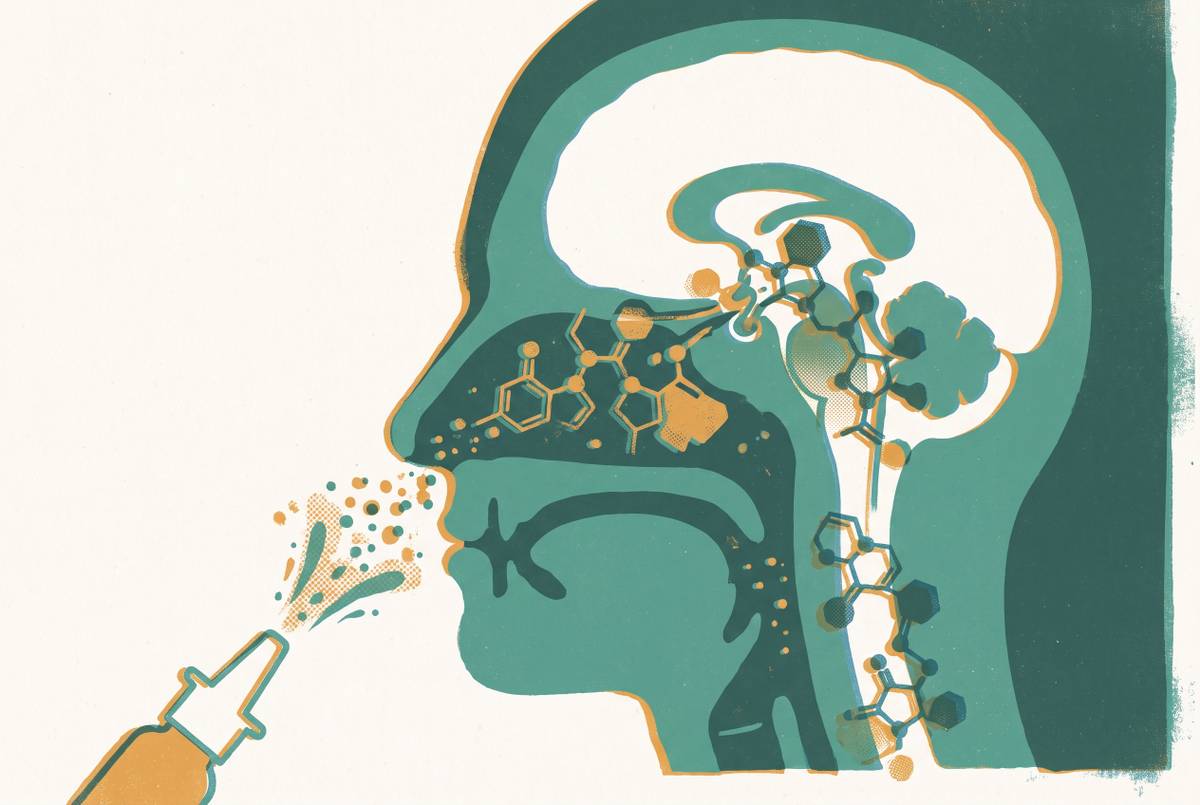
Nose-to-brain delivery instead uses the links between the nasal mucosa and the brain. The olfactory pathway, associated with cranial nerve I, runs through the cribriform plate to the olfactory bulb, with onward distribution to regions including the hippocampus and cortex. Extracellular perineural transport can move molecules within minutes. The trigeminal pathway, associated with cranial nerve V, serves a broader area of respiratory epithelium and projects toward the brainstem through the trigeminal ganglion. Its intracellular axonal transport is slower, but its accessible nasal surface is larger.
Not all nasal absorption follows these neural routes. Drug can also enter the systemic circulation through nasal blood vessels, which restores the same brain-access problem faced by peripheral dosing. The distinction is essential when interpreting a nasal study. Detecting drug after nasal administration does not, by itself, establish selective nose-to-brain transport. The distribution between brain and plasma helps distinguish the intended mechanism from ordinary systemic absorption.
What IV delivery actually achieves for CNS peptides, and where it structurally fails
IV delivery provides familiar infusion infrastructure and reliable access to circulation. Those strengths suit peripheral peptide indications, but they do not remove the barrier between blood and brain. For unmodified CNS peptides, systemic exposure can therefore rise without a corresponding gain at the target. Peripheral toxicity may become the limiting factor first. Could dose escalation solve the problem if the brain receives only a small fraction of the dose? For peptides with dose-limiting nausea or other gastrointestinal effects, that option is constrained.
The EVOKE and EVOKE+ Phase 3 trials tested oral semaglutide and illustrate the limits of peripheral delivery. Results reported in late 2025 showed changes in some biomarkers, but early Alzheimer’s disease progression did not slow significantly, and there was no cognitive or functional benefit. These findings make insufficient brain exposure an important, unproven hypothesis for the failure. They also do not establish that GLP-1 receptor biology is clinically validated for Alzheimer’s disease.
Tividenofusp alfa provides a contrasting regulatory precedent. Its FDA accelerated approval in March 2026 for Hunter syndrome / MPS II demonstrates that engineered IV transport can support a CNS-directed biologic. The approach required molecular redesign for transferrin receptor-mediated transcytosis. That is a substantial qualification. Approval in a rare lysosomal storage disease establishes feasibility for a highly engineered molecule.
What intrathecal delivery costs clinically, and why those costs constrain the indications it can serve
Intrathecal delivery removes the endothelial barrier but introduces a procedural burden. Repeated lumbar punctures or implanted systems require clinical infrastructure, while pumps demand continuing management. Infection and device dysfunction are persistent concerns. Severe neurological injuries are also documented complications, and narrow therapeutic windows make controlled dosing especially important. Direct CSF access does not guarantee even distribution across the brain or eliminate peripheral exposure.
The benefits and risks weigh differently for a severe neurological condition with no other treatment than for a chronic condition that needs treatment over years. The same access procedure may be acceptable in the former and difficult to justify in the latter. This is not simply a question of convenience. Procedural risk becomes part of the treatment’s clinical proposition, regardless of how promising the peptide itself may be.
Does an existing approval make the route “de-risked”? Nusinersen, Biogen’s antisense oligonucleotide approved by the FDA in 2016 for spinal muscular atrophy, provides a real precedent, but not a peptide-specific or route-generic guarantee. Its approval arose in a severe pediatric disease with no alternatives and extraordinary regulatory accommodation. That context cannot be transferred unchanged to adult metabolic or neurodegenerative conditions. When a less invasive option could work, intrathecal development must show why direct access is worth the added burden.
What nose-to-brain delivery offers that the other two routes structurally cannot replicate
Nose-to-brain delivery offers a combination absent from the other two approaches. Neural transport can bypass the blood-brain barrier without redesigning the peptide for endothelial transport, while nasal administration avoids lumbar puncture and implanted pumps. That combination could support treatment outside procedural settings. For neurodegeneration, addiction, and metabolic brain disease, it could allow ongoing dosing without repeated invasive access. The relevant claim is therefore not that nasal delivery already matches intrathecal exposure in humans, but that it offers a different balance of access and burden.
Preclinical findings support that distinction while showing why formulation is central. Rat studies found greater brain and CSF delivery of intranasal talinolol than of IV talinolol. Leucine-enkephalin provides a peptide-specific example. In the reported work, it reached the brain only when formulated as nanoparticles and administered intranasally, with no detectable peripheral exposure. This result supports selective delivery under the tested conditions, rather than proving that any peptide placed in the nose will reach the brain.
MetP Pharma AG, based in Emmetten, Switzerland, reported preclinical findings in January 2026 showing rapid, dose-dependent brain targeting of peptide-based drugs using its nasal technology. Brain-to-plasma ratios were consistently greater than 1, which supports preferential CNS exposure in those experiments. Landmark Medicines Ltd., based in Loughborough, UK, announced plans in September 2026 to advance its nasal platform toward a human volunteer study, with GLP-1 receptor agonists as the initial application. These are early nasal delivery programs whose clinical efficacy and nanoparticle platforms still require validation in humans.
Against the peripheral trial results, the next question is sharper. Would preferential brain delivery change the therapeutic result for peptide-based drugs in Alzheimer’s disease? Nasal delivery offers a way to investigate the exposure hypothesis. The same distinction could allow the platform to serve more neurological indications, since neural pathways reach brain regions involved in several of them. Access to those regions creates a development opportunity.
The genuine obstacles nose-to-brain must still clear — and why they are engineering problems, not biological dead-ends
The species-translation gap is the strongest objection. Rodent olfactory epithelium covers roughly forty to fifty percent of nasal surface area, compared with less than ten percent in humans. In humans, it also sits in an upper nasal recess where standard sprays deposit poorly. Animal efficiency cannot simply become a human forecast. Specialized deposition technology must account for that difference in anatomy, since formulation alone cannot get the dose to the intended site.
Even correctly deposited peptides face rapid losses. Mucociliary clearance removes most deposited material within minutes, while proteolytic activity begins degrading unprotected peptides before meaningful absorption. Nanoparticle encapsulation is intended to address these competing constraints by protecting the peptide and supporting its opportunity for uptake. Cell-penetrating peptide-decorated nanoparticles extend that approach toward mucosal penetration and neural pathway uptake. Engineering can tackle these specific problems, though that does not ensure that every peptide formulation will overcome them.
Winterdahl et al.’s 2025 first-in-human intranasal oxytocin PET study detected brain uptake within roughly half an hour, but exposure was low and variable. The pathway was accessible under the study conditions. Reproducible therapeutic delivery, however, remains a separate test, and that is where device performance and formulation optimization must earn their place.
How the three routes score when regulatory path, clinical burden, and indication fit are assessed together
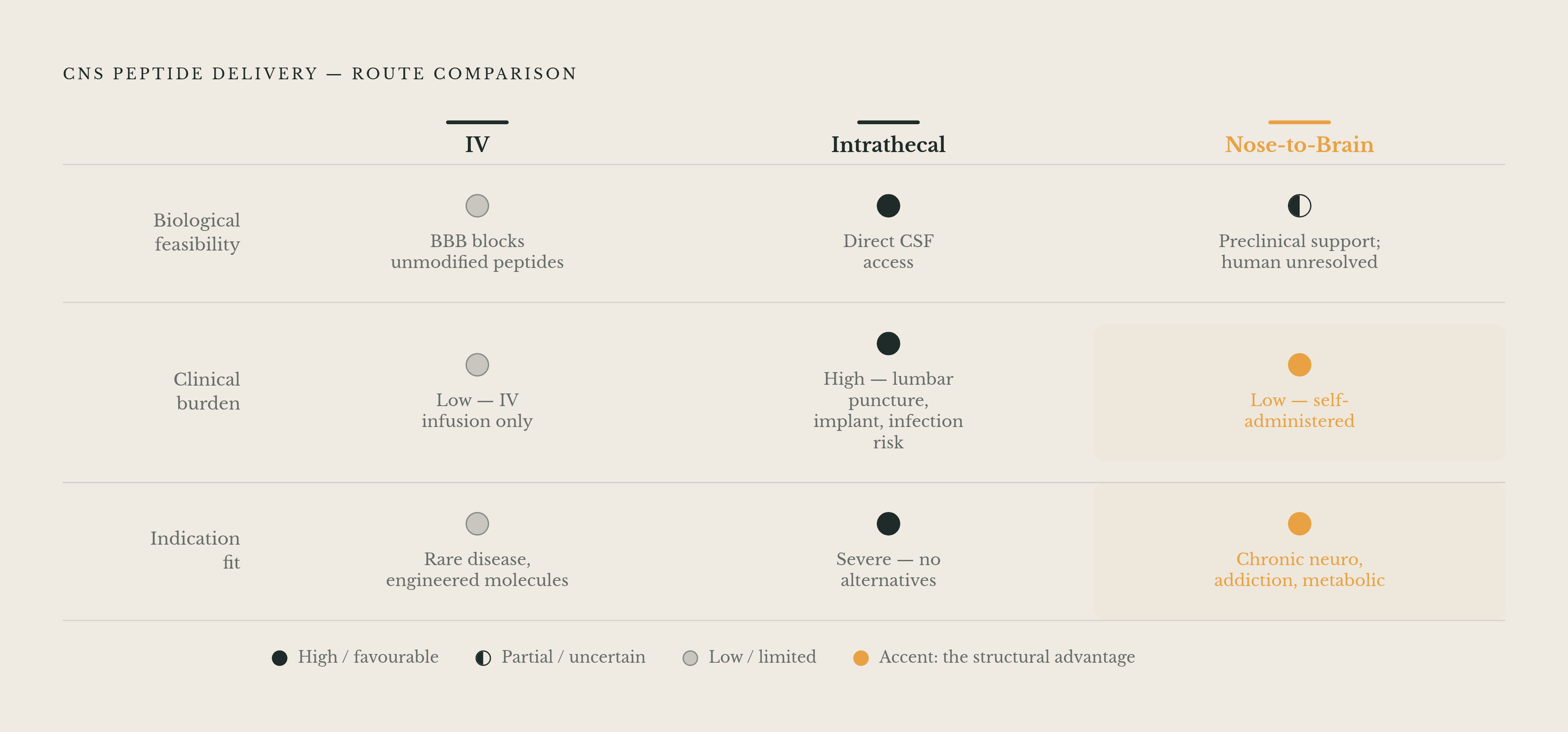
On biological feasibility, IV scores low for unmodified peptides and higher where engineered transport is available. Its clinical burden is relatively low because infusion infrastructure is familiar, while the engineered molecule and the case for its development make regulatory work more complex. Its strongest CNS precedent here is rare disease. It scores less well for chronic indications that need sustained brain exposure without substantial peripheral exposure. This narrows the conditions under which IV delivery’s strengths address the actual problem.
Intrathecal delivery scores high for direct CSF access and high for clinical burden. Its regulatory precedent is stronger than that of nanoparticle nose-to-brain peptides, but the invasiveness imposes a demanding benefit-risk justification. Severe conditions without acceptable alternatives are its clearest fit. Broad, community-based chronic use is a less natural fit because the delivery procedure remains part of every treatment plan. Nor does high CSF exposure resolve the question of distribution within the CNS.
Nose-to-brain delivery scores favorably on potential clinical burden and indication breadth, but remains less established in human translation and regulatory predictability. Non-invasive dosing that patients could give themselves suits chronic treatment without the need for settings equipped for procedures. Biological feasibility is supported by preclinical selectivity and human pathway uptake, while reliable therapeutic exposure remains unresolved. Its regulatory position is also still developing. The distinctive advantage is not current evidentiary leadership, but the prospect that improved deposition and formulation could expand its useful indications without adding invasive access or peptide-specific BBB transport engineering.
What needs to happen for nose-to-brain to convert its structural advantages into regulatory and clinical reality
A device must get the dose to the right nasal region, and the formulation must handle clearance, degradation, and penetration after deposition. Neither can compensate fully for failure of the other. Nanoparticle encapsulation and cell-penetrating peptide decoration provide a methodological basis for tackling those constraints, while artificial intelligence-driven formulation design is an emerging research direction for accelerating optimization. The development task is to turn these approaches into reproducible human performance.
Regulatory work must proceed alongside that translation. The EMA’s revised guideline, adopted in July 2025 and effective 1 February 2026, explicitly covers nasal products with CNS effects achieved through the nose-to-brain route. It would therefore be inaccurate to describe the field as having no regulatory coverage. Standardized guidance specifically tailored to CNS-targeted nasal delivery is still lacking. Early programs must produce evidence that helps set out how to assess targeting, exposure, and delivery performance.
Landmark’s planned volunteer study and MetP’s search for partnerships for further preclinical and clinical development are steps toward that evidence. They remain early-stage efforts awaiting clinical validation. A nanoparticle platform that addresses protection and mucosal penetration, paired with effective human deposition technology, could support GLP-1 neurological applications, addiction peptide targets, and neurodegeneration candidates. Each would still need its own evidence, but work on delivering it to the brain could build on the platform.
Sources
- Cell-Penetrating Peptide-Decorated Nanovectors for Nose-to-Brain Delivery: A New Treatment Option for CNS Diseases
- Intranasal Nano-Delivery Systems: Emerging Strategies for Central Nervous System Disease Therapeutics - PMC
- Nose-to-Brain Delivery of Therapeutic Peptides as Nasal Aerosols
- Nose-to-Brain (N2B) Delivery: An Alternative Route for the Delivery of Biologics in the Management and Treatment of Central Nervous System Disorders