Nanoparticle Architecture for Mucosal Peptide Delivery
How particle material, size, and coatings decide intranasal GLP-1 delivery.
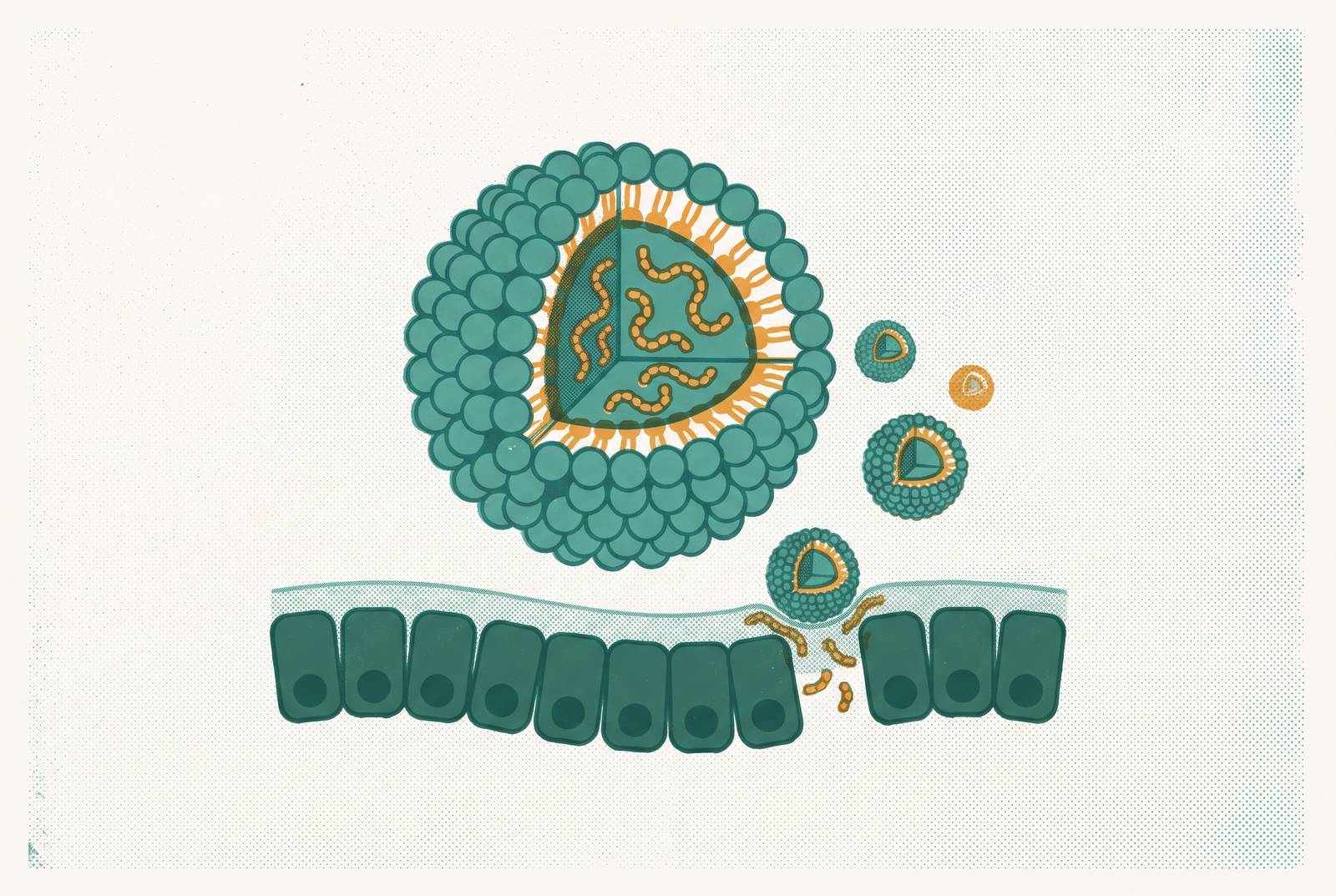
Nanoparticle architecture for mucosal peptide delivery is the engineering of a carrier that protects its cargo, crosses mucus, engages the epithelium, and reaches the intended transport pathway. For intranasal GLP-1 delivery, these are interdependent tasks. A viable platform must match particle material, size, surface chemistry, formulation support, and delivery device while remaining reproducible enough for clinical development.
Why unformulated peptides fail at mucosal surfaces
Unformulated peptides encounter three linked barriers at the nasal surface, namely enzymatic degradation, mucociliary clearance, and insufficient residence time on the epithelium. Native GLP-1 has a circulating half-life under two minutes, while locally expressed peptidases create a further challenge in the nasal environment. A peptide can therefore lose its integrity before absorption begins. Protection is only part of the problem. Mucociliary clearance can also sweep intact drug away from the olfactory and trigeminal regions before meaningful transcellular transport occurs.
These barriers reinforce one another because the time available for absorption is also time spent exposed to degradation and removal. Nasal bioavailability of unformulated peptides sits in the low single digits, leaving little of the administered dose available for therapeutic action. Would simply extending contact solve the problem? Not if the peptide remains exposed to enzymes throughout that longer stay. The carrier must preserve the molecule while giving it a useful opportunity to cross the tissue.
How the olfactory and trigeminal pathways create a viable route to the brain
The olfactory and trigeminal nerves give nasal delivery its distinctive opportunity by providing anatomical pathways to the central nervous system that bypass the blood-brain barrier. Systemically administered drugs must cross that barrier after they enter circulation. Nasal-to-brain transport offers a route around it instead. This explains why engineering through the mucosal barriers is worth pursuing for brain-targeted peptides.
The olfactory epithelium occupies a small area at the nasal roof, where deposited drug can move along olfactory neurons into the olfactory bulb and onward to deeper brain structures. The trigeminal nerve supplies the respiratory mucosa and provides a second pathway toward the brainstem and connected regions. A particle that survives in the nose has not necessarily reached either pathway in a useful way.
GLP-1 receptors in the hippocampus and cortex provide a biological rationale for pursuing this route in cognition and neurodegeneration. Receptor expression points to a target, and whether the peptide can reach it depends on deposition, mucosal transport, and where it goes after that. A nanoparticle must consequently deliver intact peptide through the pathway relevant to the intended CNS target to achieve more than improved nasal absorption.
Why particle class is the first architectural decision
The choice among lipid-based, polymeric, protein-based, and inorganic carriers establishes the material constraints within which later modifications must work. If membrane interaction is the main problem, lipid-based systems are a place to start because they are made of materials like those in cell membranes and support epithelial interaction and transcellular transport. Lipid-based carriers are the most studied class for intranasal CNS delivery. Within the studied lipid formulations, solid lipid nanoparticles predominate, followed by nanostructured lipid carriers.
A solid lipid nanoparticle provides a rigid matrix that slows enzymatic access to encapsulated peptide compared with a fluid liposomal membrane. A nanostructured lipid carrier incorporates liquid lipid pockets, increasing loading capacity and allowing release kinetics to be tuned. If mechanical stability and flexible surface functionalization take priority, biodegradable polymeric nanoparticles offer a different foundation, with biocompatible degradation products and controllable degradation.
Protein-based carriers, including albumin and ferritin, can exploit endogenous receptor-mediated transcytosis and may reduce immune recognition. Inorganic materials, including silica, gold, and iron oxide, offer precise size control and surface chemistry, but their safety and clearance profiles are less established in CNS applications. Why, then, do so many experiments emphasize coatings? Coatings can greatly change how a material interacts with what is around it. They cannot erase its underlying structure or make a lipid shell behave like a rigid polymer matrix.
Size and surface charge as gatekeepers of mucosal penetration
Carriers too large to move through the mucin-fiber mesh of nasal mucus become immobilized and vulnerable to mucociliary clearance, regardless of how well their material protects the peptide. Material selection alone is therefore insufficient.
Surface charge, characterized through zeta potential, governs a different part of the same encounter. Positively charged particles interact with the negatively charged mucin network, favoring adhesion and longer local contact, while neutral or near-neutral particles generally penetrate more freely. Neither behavior is universally preferable. Adhesion may give a particle more time to interact with tissue, but it can also hold the particle in mucus and keep it from reaching the cells beneath.
Is its main limitation rapid removal, or difficulty crossing the mucus layer? Those problems favor different charge strategies. Maximizing mucoadhesion and mucopenetration at once is not a straightforward specification because the interactions that promote one can impede the other. Surface engineering is needed when the formulation must get through both stages and a surface that helps with just one will not suffice.
Surface coatings that resolve the mucoadhesion–mucopenetration trade-off
Chitosan coatings illustrate how a surface modification can change a carrier’s biological role. The cationic polysaccharide adheres to mucosal surfaces through electrostatic and hydrogen-bond interactions, extending residence time and temporarily opening tight junctions to support paracellular transport. Its purpose goes beyond making particles stick. For nose-to-brain delivery, longer residence can provide more time for interaction with the olfactory and trigeminal regions before clearance removes the dose.
Cell-penetrating peptides extend this strategy toward more active epithelial engagement. Short cationic sequences such as L-penetratin facilitate transcellular uptake once the formulation reaches the cell surface, rather than relying only on prolonged contact or paracellular passage. Preclinical models have shown improved bioavailability for insulin, GLP-1, and exendin-4 with L-penetratin. That evidence supports epithelial uptake as an engineering target. It does not show that the same gain will occur in humans or directly lead to more peptide reaching the brain.
PEG coatings pursue a contrasting objective by forming a hydrophilic, electrically neutral brush that limits mucin adhesion and promotes penetration. The cost is reduced cell-surface adhesion after mucus transit. Emerging designs seek to sequence these functions, for example through a PEG outer layer that sheds to expose a cationic or CPP-decorated surface. Lipid-polymer hybrids meet another set of needs by joining a stable, controlled-release polymeric core to a lipid shell that helps with membrane affinity and allows surface modification.
Enzyme inhibition and permeation enhancers as formulation co-strategies
Encapsulation does not entirely prevent enzymatic degradation. Nasal mucosa expresses aminopeptidases and proteases, while DPP-4 expression is limited or variable and occurs primarily in submucosal glands, with less expression in the surface epithelium. Local GLP-1 degradation therefore differs from degradation in circulation. Protection must account for peptide outside the carrier as well as the encapsulated fraction.
Why add an enzyme inhibitor to an already protective nanoparticle? Encapsulation efficiency is rarely complete, and peptide released early can be exposed before it reaches a site where it can be absorbed. The release zone near the epithelium is itself enzymatically active. Inhibitors such as aprotinin or bestatin added to the formulation can slow degradation of that exposed fraction, protecting peptide outside the particle too.
Permeation enhancers address the separate problem of tissue transit by transiently altering tight-junction integrity or membrane fluidity. Their benefit comes with a constraint, as repeated dosing can create risks of mucosal toxicity. Combining enhancers and inhibitors can address poor absorption and degradation together, but adds manufacturing and regulatory demands. Each added component must be controlled and shown to be safe. A formulation that performs better biologically may consequently become harder to translate.
How device geometry shapes where particles actually land
Standard liquid nasal sprays deposit most drug in the anterior respiratory mucosa, a high-clearance region with poor access to the olfactory epithelium at the nasal roof. This creates a mismatch for particles designed around olfactory contact. Adhesion at the wrong site cannot get the drug to the site it needs to reach. The device must bring the carrier into contact with the region for which its surface was engineered.
Bidirectional devices use recirculating airflow to direct particles posteriorly and superiorly, improving deposition toward the olfactory region. Precision olfactory delivery technology directs aerosolized drug toward the olfactory cleft to increase contact with the neural transport zone. These approaches address spatial access. Their contribution depends on whether the deposited formulation can then perform its intended biological tasks.
Device geometry and particle architecture therefore matter equally in the design. A mucoadhesive formulation deposited in the respiratory turbinates may behave as a conventional nasal drug rather than realize its intended olfactory-targeting advantage. This does not mean that respiratory deposition excludes every neural pathway, since the trigeminal route remains anatomically relevant. It means that the delivery location must match the transport hypothesis. Whether that match persists in humans is a central translational question.
The translational gap between preclinical architecture and clinical proof
No nanoparticle-based peptide formulation for intranasal delivery has received FDA approval, and very few intranasal nanocarrier studies have progressed to human clinical trials. Better absorption, protection, or targeting in preclinical studies does not prove that the formulation works in patients. The whole delivery system still needs to be tested, even when its individual materials have useful properties.
Rodent and human nasal anatomy differ in ways that affect deposition, clearance rate, and olfactory surface area. Those differences complicate the interpretation of preclinical bioavailability gains because the same formulation-device pairing may encounter a different spatial and temporal problem in humans. Manufacturing adds another independent hurdle. Maintaining particle size, coating density, and encapsulation efficiency across commercial-scale batches is distinct from producing an effective experimental formulation. Strong biological results do not establish that reproducibility.
Neuraly developed NLY01, a PEGylated exenatide analogue, which completed Phase II clinical trials for Parkinson’s disease and a Phase 2a single-dose PK/PD study in type 2 diabetes. This represents clinical progression for an engineered GLP-1 agonist, while an intranasal nanoparticle delivery system still requires proof. The distinction is essential when assessing how far the field has advanced. Chemical modification, nasal delivery, and nanoparticle transport each make a different claim, and each needs its own evidence.
Formulation complexity further raises the evidentiary burden because enzyme inhibitors, permeation enhancers, and CPPs each require safety support. Their combination also has to be manufactured consistently as a system. Continued architectural refinement is therefore justified only as part of a broader translation effort that treats production and regulatory requirements as design problems. The preclinical gap prevents a promising mechanism from being presented as a proven therapy.
What the design logic reveals about the path forward for GLP-1 intranasal delivery
A viable intranasal GLP-1 platform must reconcile protection, mucus transit, epithelial interaction, regional deposition, and reproducible manufacture. Those requirements constrain one another. Greater adhesion may impede penetration, stronger protection must remain compatible with release, and additional formulation support increases the burden of characterization. Progress depends on platform-level thinking because an improvement at one stage can create a new limitation at the next.
GLP-1 receptor expression in brain regions linked to cognition supports investigation, but it does not establish cognitive benefit in patients with established disease. Early intervention or prevention is a different design target from rescue therapy. Likewise, population-level risk reduction is not equivalent to disease modification. Better delivery must help achieve a clear treatment goal, and that benefit still needs to be shown.
An intranasal format that eliminates injection and reduces nausea could address more than one cause of treatment discontinuation, but reduced nausea remains a condition to demonstrate. Therapeutically meaningful exposure is equally necessary. Deeply validated platforms may have an advantage through accumulated manufacturing and characterization knowledge, rather than through a single striking preclinical result. For a patented platform, that distinction makes reproducible performance more informative than an unsupported claim of superiority. The whole system must preserve its biological function as it moves from experimental architecture to human use.
Sources
- Navigating the Nose-to-Brain Route: A Systematic Review on Lipid-Based Nanocarriers for Central Nervous System Disorders
- Nanocarrier-based intranasal drug delivery for enhanced neurological disorders treatment
- Full article: A comprehensive insight of innovations and recent advancements in nanocarriers for nose-to-brain drug targeting
- Nose-to-brain drug delivery: from bench to bedside
- Intranasal drug delivery: Pathways, challenges, and advancements in CNS targeting - ScienceDirect
- Lipid and Polymeric Nanoparticles: Successful Strategies for Nose-to-Brain Drug Delivery in the Treatment of Depression and Anxiety Disorders
- Advancements in Nanocarrier Systems for Nose-to-Brain Drug Delivery
- Intranasal drug delivery: Unlocking the nose-to-brain route for central nervous system therapies - ScienceDirect