Tirzepatide vs. Semaglutide as Dual and Single Agonist Platforms
Two receptors beat one on weight loss, but not on heart data.

Semaglutide and tirzepatide are often discussed as rival drugs in the same weight-loss category, but they represent two different engineering choices: one receptor target versus two. That architectural choice, not dosing or branding, is what explains why the two drugs diverge on weight loss, blood sugar control, heart outcomes, and side effects, and it is the lens this piece uses throughout.
What semaglutide and tirzepatide are, at the receptor level
Semaglutide works through a single receptor system. It is a selective GLP-1 receptor agonist, built to copy the body's own GLP-1 hormone closely enough that it binds the same receptors found in the pancreas, the gut, and the brain. Once those receptors bind, they tell the pancreas to release more insulin, they slow down how fast the stomach empties, and they dial back appetite signals in the brain. That is a coherent, single-channel system, and most of what semaglutide does in the body can be traced back to that one lock-and-key relationship repeated across several tissues.
Tirzepatide starts from the same GLP-1 receptor but adds a second lock: the glucose-dependent insulinotropic polypeptide receptor, or GIP receptor. That makes tirzepatide a dual GIP/GLP-1 receptor agonist, and it would be easy to assume this is just semaglutide plus a bonus feature bolted on. The two-receptor design does not simply add a second signal on top of the first. It changes the overall shape and strength of the metabolic message the body receives, because GIP and GLP-1 signaling interact with each other rather than running in parallel, untouched lanes.
Molecular pharmacology work on tirzepatide adds a further wrinkle to that picture: the dual agonism is not even. Tirzepatide is a molecule leaning heavily on GIP activation while carrying an altered, somewhat muted version of the GLP-1 signal, which undersells how differently it behaves from simply combining two separate single-agonist drugs when calling it "two drugs in one.
As peptide delivery itself turns into a variable that can be engineered, the delivery route may start to matter as much as the choice between one receptor and two.
What the mechanistic difference produces in head-to-head clinical trials
The receptor-level distinction described above is not just an academic curiosity. It appears consistently in head-to-head trials testing semaglutide and tirzepatide against each other. A 2026 narrative review of clinical trials, covering head-to-head randomized studies including SURPASS-2 and SURMOUNT-5, found tirzepatide produced greater reductions in body weight and HbA1c than semaglutide in people with obesity or type 2 diabetes. A 2025 systematic review and meta-analysis of direct comparative studies pooled four trials, and mean weight loss consistently favored tirzepatide over semaglutide across that pooled analysis.
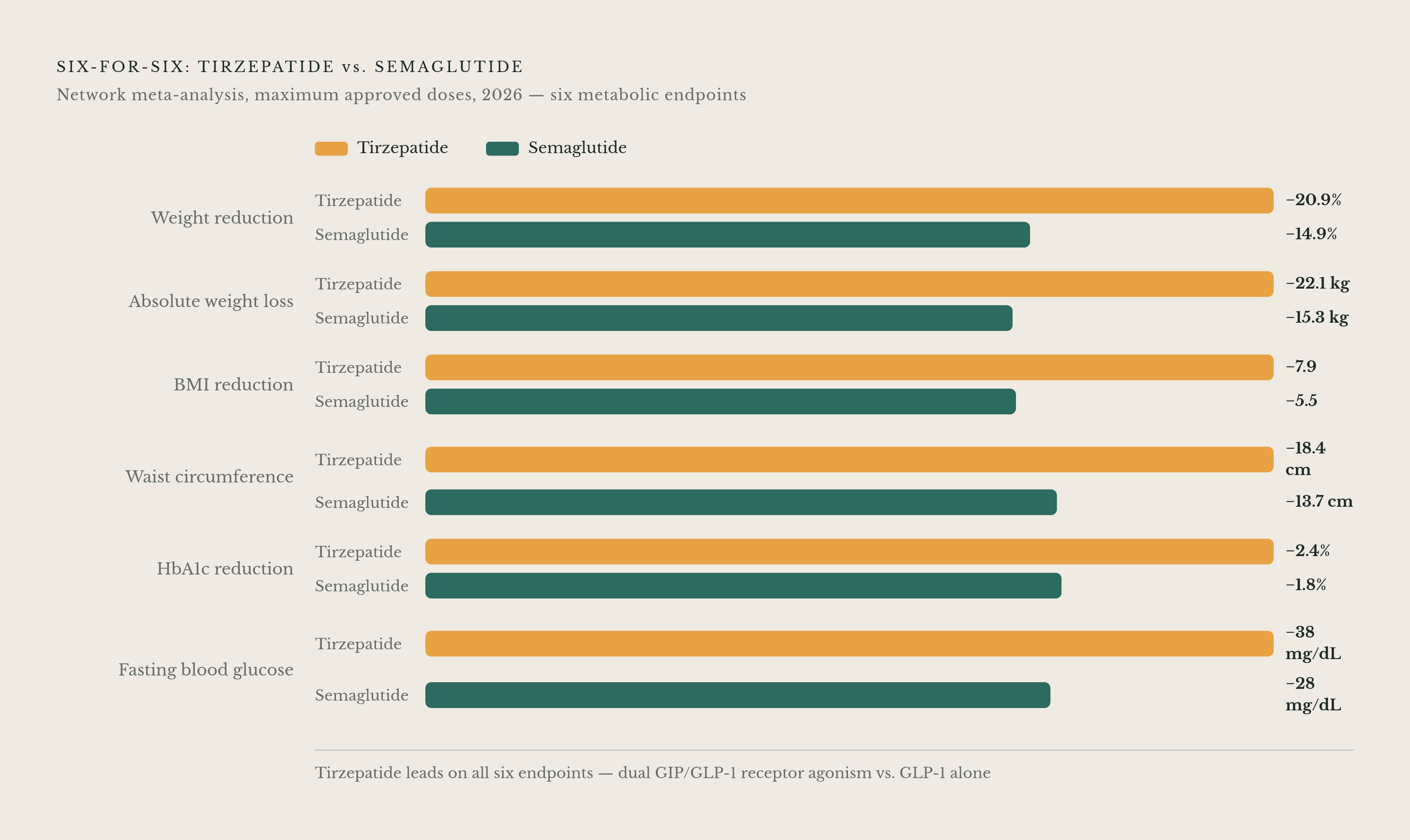
A 2026 network meta-analysis went further, comparing the two drugs at their maximum approved doses across a full slate of metabolic measures: percentage weight reduction, absolute weight loss, BMI reduction, waist circumference reduction, HbA1c reduction, and fasting blood glucose. Tirzepatide came out ahead on every one of those endpoints. That breadth matters: a sweep across six different measures points back to the underlying mechanism rather than to any one study's quirks, since a single favorable metric could be explained away as noise or as an artifact of how one trial was designed.
Real-world evidence lines up with the trial data; it does not complicate it. A large propensity-matched cohort study, run by researchers including authors at the University of Texas Medical Branch using the multicenter TriNetX Research Network, found tirzepatide associated with lower all-cause mortality, lower incidence of major adverse cardiac events, and better glycemic control than semaglutide at one year among matched patients with obesity and type 2 diabetes. That a database built from ordinary clinical practice tells roughly the same story as the controlled trials strengthens the case that the dual-receptor design is doing real work, not just producing a statistical artifact of trial conditions.
Cardiovascular risk reduction is the one place where the evidence now tilts back toward semaglutide. Semaglutide has the more mature track record on heart outcomes, shown in SUSTAIN-6 and the SELECT trial. Tirzepatide's own cardiovascular trial, SURPASS-CVOT, established non-inferiority against dulaglutide, but a direct head-to-head cardiovascular outcomes trial pitting tirzepatide against semaglutide has not been completed. A patient and physician weighing these two drugs are not choosing a flat winner. They have to choose between a dual-receptor platform with the stronger metabolic sweep and a single-receptor platform with the longer, more established cardiovascular safety record.
How the two platforms compare on tolerability
Both drugs draw from the same well of side effects, because both activate GLP-1 receptors in the gut, and gastrointestinal upset, nausea in particular, is the predictable cost of that activation regardless of whether a second receptor is also involved. The 2026 TriNetX real-world study found GI side effects slightly less frequent in the tirzepatide cohort than in the semaglutide cohort, a result that lines up with some but not all of the available research on the two drugs.
There is a proposed explanation for that edge, and it deserves to be treated carefully as a hypothesis still awaiting validation. The idea is that GIP receptor activation might blunt nausea, which has a plausible biological basis given GIP's known role in signaling gut motility. The 2026 narrative review is explicit that this remains speculative and needs further validation before it should be treated as an established mechanism. The 2025 meta-analysis backs up this caution: it found the most common adverse events for both drugs were minor-to-moderate gastrointestinal events, and it did not establish a definitive safety edge for either drug.
So the honest comparison splits into two separate questions, and conflating them is where a lot of marketing claims about dual agonism go wrong. Both drugs share a structural problem rooted in how they are delivered. Both are injected, and that shared fact, not the receptor count, turns out to be the bigger story once the comparison moves from clinical trials into ordinary practice.
Real-world adherence and the efficacy advantage
The efficacy numbers from the previous sections describe what happens when patients keep taking their medication on schedule for the full length of a trial. That is not what happens in routine care, and the gap between trial conditions and real-world use turns out to be large enough to swallow whatever edge either drug holds in a head-to-head comparison. Discontinuation in ordinary practice runs far higher than trial dropout rates, and the injectable route is consistently named as a central driver: the discomfort and inconvenience of giving yourself injections pushes a meaningful share of patients to simply stop.
The consequences of stopping early are severe rather than modest. Early dropout does not produce a partial result. It erases most of the benefit the drug was capable of delivering.
Long-term numbers are worse still. Only a small minority of patients remain on a weight-management injectable after three years. That means the carefully measured efficacy curves from 72-week and 80-week trials describe a population that looks less and less like the patients actually using these drugs in practice, because most of the people who would have been measured at year three already dropped out long before the clock got there.
Patients still stop taking the drug because of the injection itself. A structured pharmacist-led program, run through an integrated health-system specialty pharmacy with structured onboarding and follow-up, achieved dramatically lower one-year discontinuation than standard care produced. The deeper cause is that even tirzepatide, with its stronger pharmacology, still depends on a needle, and structured support programs work by compensating for that shared burden. No improvement in receptor architecture solves a patient's reluctance to inject themselves day after day, month after month.
Receptor-targeting logic and neurology
GLP-1 receptors are not confined to the pancreas and gut. They show up throughout the central nervous system, where they play a role in synaptic plasticity, neuroinflammation, insulin signaling in brain tissue, and how neurons manage their own energy supply. That means both semaglutide and tirzepatide carry implications well beyond metabolism, because the same receptor that suppresses appetite in the hypothalamus is doing other work elsewhere in the brain. The separation between what happens in the body and what happens in the brain is real but not absolute, and that overlap is what has drawn serious research attention toward addiction and neurodegenerative disease.
In addiction research, population-level studies associate GLP-1 receptor agonist use with fewer hospitalizations for alcohol use disorder, fewer new diagnoses of the condition, and fewer opioid overdose events. These findings align with the hypothesis that GLP-1 signaling influences dopamine-driven reward circuits in the brain. Tirzepatide is now the subject of ongoing trials in alcohol-related outcomes. The picture here is still being assembled, not finished.
Neurodegeneration research tells a similarly mixed story. Preclinical models of Alzheimer's disease and Parkinson's disease have shown GLP-1 receptor agonists can reduce neuroinflammation, improve how mitochondria function, and help clear the toxic proteins associated with these diseases. A large longitudinal cohort of people with type 2 diabetes found GLP-1 receptor agonist use associated with a reduced incidence of dementia compared to non-use. That is a meaningful epidemiological signal, but it is not the same as proof from a randomized trial.
Clinical results in Alzheimer's disease have been disappointing so far. Every completed randomized trial in Alzheimer's disease has failed to hit its primary endpoint. The EVOKE and EVOKE+ trials found neutral results on secondary cognitive and functional measures, and a pooled analysis found no delay in the progression from mild cognitive impairment to mild Alzheimer's disease. Parkinson's disease evidence has held up somewhat better: lixisenatide showed motor benefits in trial results, and earlier exenatide trials produced positive motor signals, though the phase 3 Exenatide-PD3 trial did not meet its primary endpoint, and a separate pegylated exendin trial also missed its primary endpoint. Preclinical promise and epidemiological association have not yet translated cleanly into randomized trial success, and that gap between what the biology suggests and what controlled trials confirm deserves honest acknowledgment.
How these drugs reach the brain may explain part of that gap. Subcutaneous injection requires the drug to cross the blood-brain barrier, a membrane built specifically to keep most circulating substances out of brain tissue, and that barrier limits how much drug gets where it needs to go and how safely it can get there. Research into intranasal GLP-1 delivery identifies this blood-brain barrier constraint as a core limitation of the injectable route for any neurological application. Adding a second receptor target does not change this. Tirzepatide's GIP receptor agonism does nothing to help the molecule cross the barrier more efficiently, so its metabolic advantage over semaglutide does not carry over into an advantage for brain-targeted indications. If the next era of GLP-1 science is going to involve the brain as directly as it has involved the pancreas and the gut, the question of how the drug gets there starts to matter as much as which receptors it hits once it arrives.
Nose-to-brain delivery and the structural limits of both platforms
The blood-brain barrier limitation described above is a delivery problem, not a binding problem, and neither receptor architecture can engineer its way around it. Intranasal delivery offers a different route: drug administered through the nose can travel along the olfactory and trigeminal nerve pathways directly into brain tissue, bypassing the blood-brain barrier. So both single-agonist and dual-agonist molecules get a path to direct CNS access that subcutaneous injection cannot give either one, no matter how many receptors the molecule targets once it gets there.
Research into intranasal GLP-1 delivery describes this nose-to-brain route, moving through the olfactory and trigeminal nerves, as the specific path by which intranasally administered peptides reach brain tissue without first entering systemic circulation.
Preclinical work backs up that this is not just a theoretical possibility for peptides like these. Intranasal administration has achieved brain-to-plasma ratios greater than 1 in these studies, so more drug concentration shows up in brain tissue than in the bloodstream, the signature of preferential CNS delivery. That is a pharmacokinetic profile injectable routes are not built to produce, since injection sends the drug into systemic circulation first and leaves it to the blood-brain barrier to decide how much gets through afterward.
The same logic reaches back into the metabolic side of this comparison as well. Lionbio's work on intranasal nanoparticle delivery for GLP-1 peptides is aimed at this exact mechanism, potentially reducing the gut-level receptor activation that triggers nausea in the first place, independent of whether the underlying molecule is a single agonist like semaglutide or a dual agonist like tirzepatide.
That is the real throughline connecting every section of this comparison. Receptor architecture, whether one target or two, shapes how powerfully a drug can act once it reaches its destination, and the clinical trial data make clear that architecture matters a great deal. But architecture has never been the only variable in play. How the drug gets to its receptors in the first place, whether through a needle into the bloodstream or through a route that reaches the brain and gut more directly, determines how much of that pharmacological promise a patient actually keeps long enough to benefit from it.
Sources
- Frontiers
- Comparative real-world outcomes of tirzepatide vs semaglutide in patients with obesity and type2 diabetes: A retrospective propensity-matched cohort study - PMC
- Tirzepatide Versus Semaglutide on Weight Loss in Type 2 Diabetes Patients: A Systematic Review and Meta‐Analysis of Direct Comparative Studies - PMC
- Who Wins the Battle Against Obesity? A Network Meta‐Analysis Comparing Tirzepatide and Semaglutide
- Intranasal delivery of glucagon-like peptide-1 to the brain for obesity treatment: opportunities and challenges: Expert Opinion on Drug Delivery: Vol 21 , No 7 - Get Access
- Tirzepatide is an imbalanced and biased dual GIP and GLP-1 receptor agonist
- Comparative safety and side effects of semaglutide and tirzepatide: Implications for clinical decision-making in obesity management - ScienceDirect